
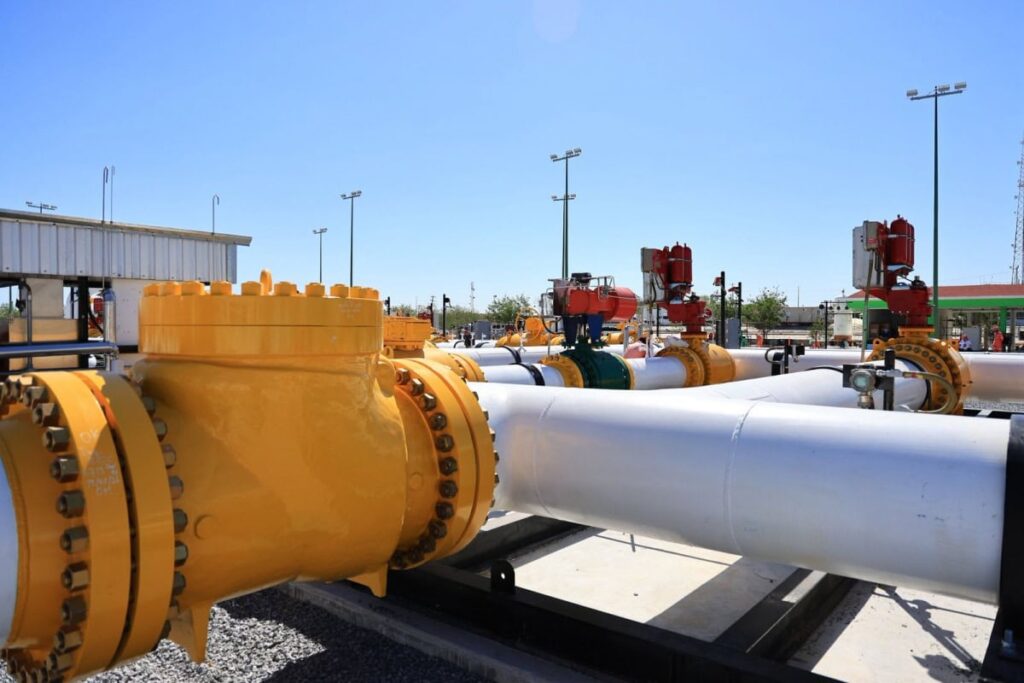
The trend in U.S. gas exports to Mexico peaked in 2022, declined for two consecutive years, and resumed growth in 2025 and 2026.
The United States began in 2016 exporting liquefied natural gas (LNG) from the 48 contiguous states. From January to April of this year, it exported this commodity to nearly 50 countries, while its exports of natural gas in gaseous form were primarily destined for Mexico and Canada.
Trend in U.S. gas exports
Exports via pipeline to Mexico have increased significantly since 2000.
From January to April of this year, Mexico imported U.S. gas with a customs value of $2.478 billion, a year-over-year increase of 4.8%, according to data from the Department of Commerce.

In Mexico, natural gas is key to electricity generation and the manufacturing industry, with high dependence on imports (via pipelines from the United States). Over the past decade, consumption has followed an upward trend due to the energy transition and industrial relocation (nearshoring).
Mexican imports of natural gas from the United States totaled $6.534 billion in 2025, a 57.5% increase over 2024.
The trend in U.S. gas exports to Mexico, in millions of dollars, is shown below:
- 2018: 2,555.
- 2019: 3,737.
- 2020: 4,075.
- 2021: 10,867.
- 2022: 12,331.
- 2023: 5,854.
- 2024: 4,149.
- 2025: 6,534.
Among the leading companies exporting natural gas from the United States to Mexico are CFE International (the largest supplier to the country), Kinder Morgan, Sempra Infrastructure, TC Energy, and Cheniere Energy.
Price Volatility
U.S. exports of this energy source to the world have rebounded in 2025 and 2026. This has occurred despite greater price volatility.
To meet this growth, U.S. natural gas production has also increased steadily, which has helped keep prices in the United States relatively stable and low compared to those in other countries.
USMCA
The United States-Mexico-Canada Agreement (USMCA) establishes clear rules to ensure legal certainty in foreign trade. Its structure includes three fundamental frameworks for dispute resolution:
State-to-State Disputes: The agreement maintains a formal framework for resolving direct differences between member countries regarding the interpretation of the agreement.
Binational Reviews: It includes a specific mechanism for challenging trade remedy measures, such as anti-dumping duties and subsidies.
Investor-State Dispute Settlement (ISDS): Unlike the former NAFTA, the USMCA limits international arbitration solely to disputes between Mexico and the United States.
ISDS Arbitration in Strategic Sectors
This bilateral mechanism primarily protects U.S. investments in Mexico, focusing exclusively on government contracts in the following key sectors:
- Oil and Natural Gas.
- Power Generation (Electricity and Renewable Sources).
- Infrastructure and Telecommunications.