
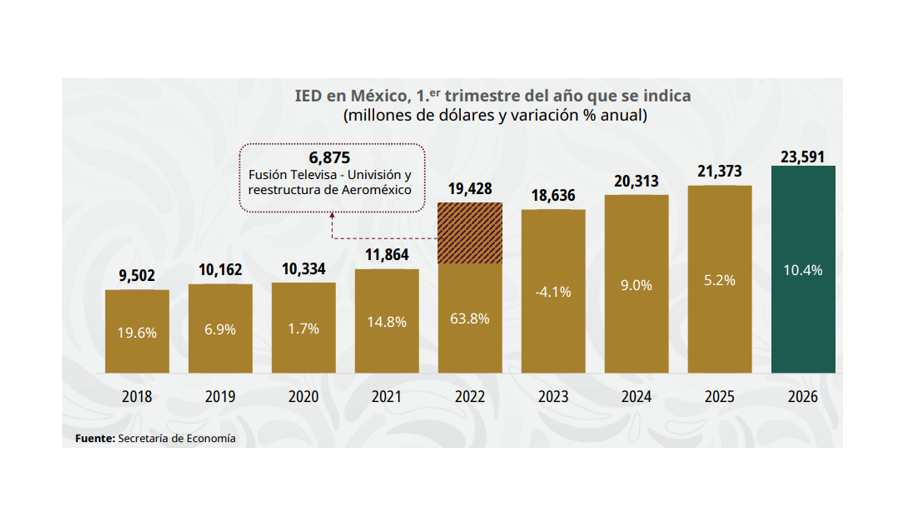
Thanks to key FDI sectors in Mexico, this indicator grew at a year-over-year rate of 10.4% in the first quarter of 2026, reaching $23.591 billion.
The figures are preliminary and tend to be revised upward in subsequent months; therefore, they are also compared with the corresponding preliminary figures when they were announced in each case.
Using this same comparison, FDI inflows to Mexico grew by 9.0% and 5.2% in the first quarters of 2024 and 2025.
Marcelo Ebrard, Secretary of Economy, presented the latest FDI data on Monday at a press conference in Mexico City.
FDI Sectors
The growth was driven primarily by the reinvestment of profits, reflecting foreign companies’ confidence in the Mexican market and in trade stability under the USMCA.
The most notable sectors in the first quarter of this year were the following:
Automobile manufacturing, auto parts, and electromobility projects in Guanajuato, the State of Mexico, and Querétaro.
Artificial intelligence, data centers, and electronic component manufacturing in the central region of the country.
Expansion of scientific research and medical device manufacturing in Nuevo León, Chihuahua, and Mexico City.
Expansion of home appliance production lines in Baja California and Querétaro.
Roads and highways in the Valley of Mexico and Puebla.
Implementation of new technologies in financial services and increased financing for SMEs.
Investments in figures
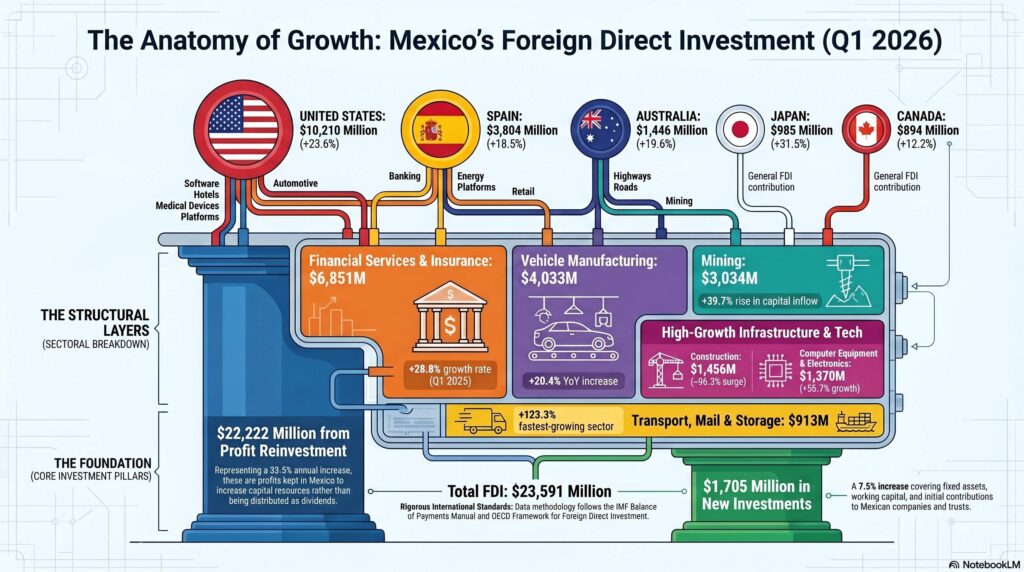
New investments totaled $1.705 billion, a 7.5% year-over-year increase. This category includes funds allocated to fixed assets, working capital, capital increases, and the acquisition of shares by foreign investors. At the same time, reinvestment of profits reached $22.222 billion, with a 33.5% increase, consolidating its position as the main driver of productive capital flows into Mexico.
Ebrard stated that international investors maintain their confidence in the country, especially U.S. companies, which continue to expand projects related to nearshoring and regional supply chains.
By sector, financial services and insurance led FDI inflows with $6.851 billion, followed by vehicle manufacturing, mining, construction, and computer equipment and electronic components. Notable was the growth in construction, with a 96.3% increase, as well as transportation, postal services, and warehousing, which rose by 123.3%.
The United States remained the leading source of foreign investment, with $10.21 billion and 23.6% growth. Spain, Australia, Japan, and Canada rounded out the group of top investors. U.S. capital was directed primarily toward software, medical devices, the automotive sector, digital platforms, and banking, strengthening Mexico’s manufacturing and technology ecosystem.