
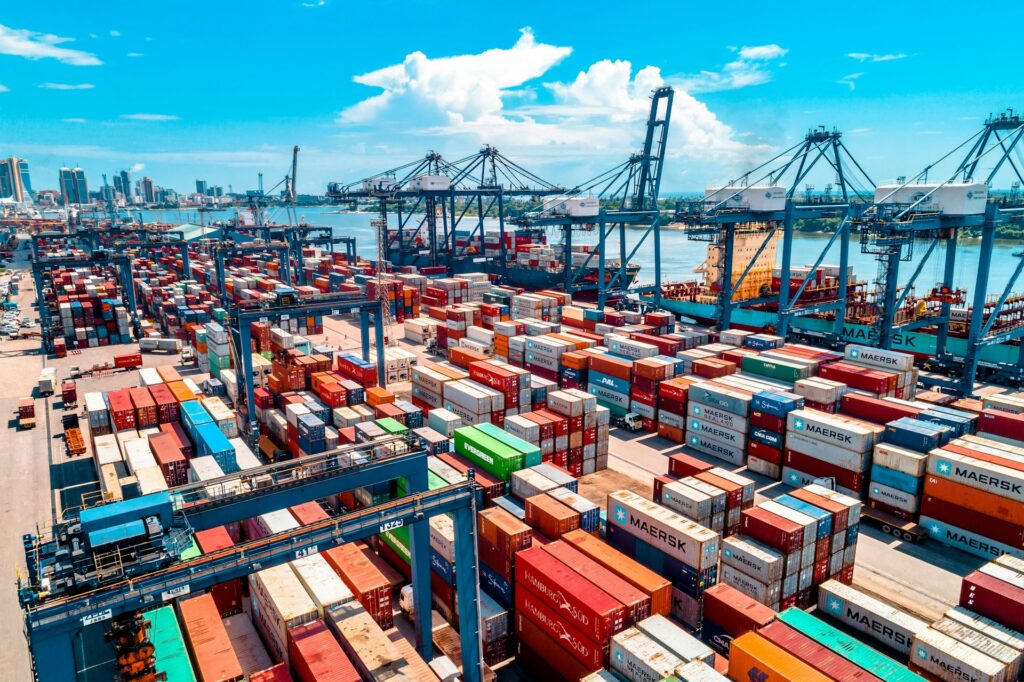
The history of international containers—ISO and TEU—began with the idea and innovation of American entrepreneur Malcolm McLean.
This story was highlighted as a prime example of the benefits of international standards in the World Development Report 2025: Standards for Development, prepared by the World Bank Group.
History of International Containers
The report introduces this section by linking logistics with regulations. Trade agreements have long been the lubricant for the gears of the global economy. They have smoothed out cross-border friction, created predictable market access, and integrated standard norms into national regulations, allowing products to circulate on a large scale.
It then highlights: the true revolution arrived quietly, and relatively recently, led by an American trucking entrepreneur named Malcolm McLean in the mid-1950s.
Until then, goods were transported using methods that had barely changed over the centuries. Cargo had to be packed piece by piece into boxes, sacks, or barrels and loaded onto carriages, trucks, trains, and ships.
At each stage, everything was unloaded from one vehicle and reloaded onto the next, usually using different specialized equipment.
McLean standardized the simple steel box, designing it to facilitate loading and shipping across all modes of transport: road, rail, air, and sea.
In doing so, he drastically reduced handling costs and times: transportation costs fell by at least 25 percent. He also reduced the risk of theft and damage.
An international container is a cargo container standardized under ISO standards, designed for the intermodal transport of goods. Its metal structure allows for safe transfer between ships, trains, and trucks without unloading the contents, optimizing global logistics through TEU units of measurement.
Just in Time
According to the same World Bank Group report, McLean’s standardization did more than just bring order to maritime transport. Standard containers gave the world a common commercial language. A container sealed in Shanghai could be unloaded in Rotterdam and loaded onto a truck, rarely opened or even touched by human hands.
The standards transformed chaos into order, fostering the economic miracles of the “just-in-time” manufacturing method. Ships grew larger. Supply chains multiplied. Trade skyrocketed. McLean further accelerated the process by granting free licenses for his container patents to the ISO.
In 1965, the ISO standardized nearly every aspect of shipping containers: dimensions, stacking rules, twist locks, strength, and lifting systems. Suddenly, there was a single reference manual and global interoperability. The result was extraordinary. Containers permanently boosted trade: a cumulative 1,240% increase in trade among advanced economies after 15 years; according to many estimates, an effect greater than the combined impact of all trade agreements from the previous half-century.
In 22 industrialized countries, standardized containers increased bilateral trade by 300% in just five years and nearly 800% over 20 years. This far exceeded the 45% increase associated with bilateral free trade agreements over the same 20-year period and the 285% increase resulting from accession to the General Agreement on Tariffs and Trade (GATT), the precursor to the WTO.