

The second report from the administration of Mexican President Claudia Sheinbaum highlighted that the Free Trade Agreement between Mexico and the European Union (CPTPP or Modernized Comprehensive Agreement—AGM) offers opportunities for premium and gourmet food exports.
The Agreement will allow virtually all Mexican exports to enter the European market under free trade terms, with preferential treatment.
This will benefit key sectors such as agri-food, beverages with a designation of origin, advanced manufacturing, the automotive and auto parts industries, medical devices, as well as the chemical and pharmaceutical sectors.
Premium Food Exports
According to the presidential report, the MGA will boost exports of high-value products in the case of industrial goods and of premium or gourmet foods in the case of agribusiness products.
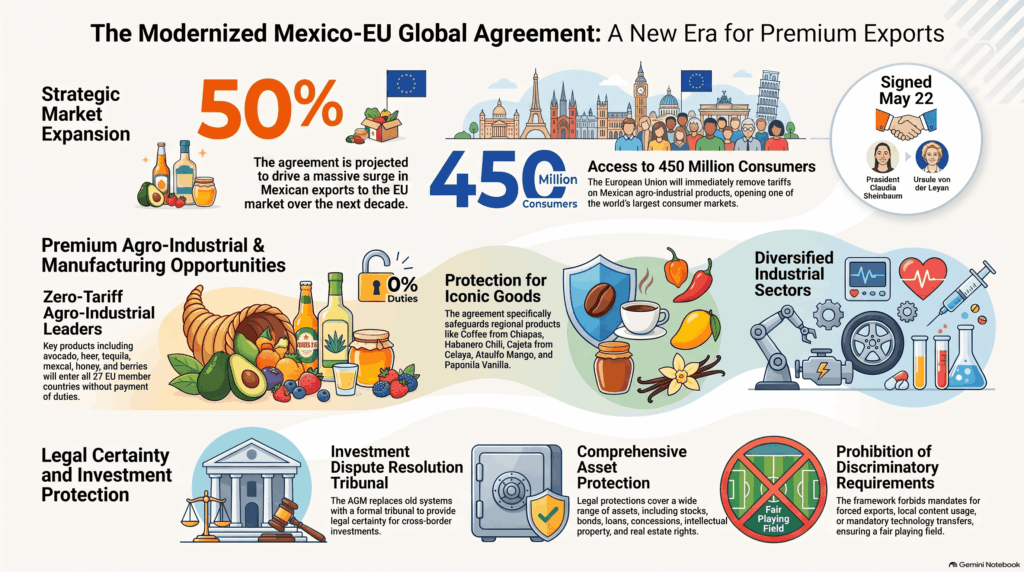
Mexico secured access to the European market with virtually total tariff liberalization. Exports of industrial goods—automobiles, auto parts, and other manufactured goods—will enter the European Union duty-free.
Mexican agro-industrial products, such as avocados, beer, tequila, mezcal, honey, and berries, will also be able to enter the 27 countries of the bloc without paying tariffs.
The agreement also protects iconic products such as Chiapas coffee, habanero chili peppers, cajeta from Celaya, Ataulfo mangoes, and Papantla vanilla.
Elimination of Tariffs
The Ministry of Economy announced that the European Union will immediately open its agri-food market of 450 million people to Mexico. With market access in the manufacturing sector—including autos and auto parts—they project a 50% increase in Mexican exports by 2030.
This will take place following the signing of the Modernized Global Agreement on May 22 by Sheinbaum and Ursula von der Leyen.
Investment Tribunal
The AGM replaces the CPTPP and establishes an Investment Dispute Settlement Tribunal. It provides legal certainty for cross-border capital, protecting shares, bonds, loans, concessions, intellectual property, and real estate rights of any investor.
The framework prohibits the imposition of discriminatory performance requirements such as forced exports, local content, or technology transfer. Additionally, it establishes the automatic extension of any more favorable treatment granted to third countries, preventing expropriations and trade distortions.