

Global demand for refined copper continued to grow in 2025, while U.S. tariffs on this product could rise in 2027.
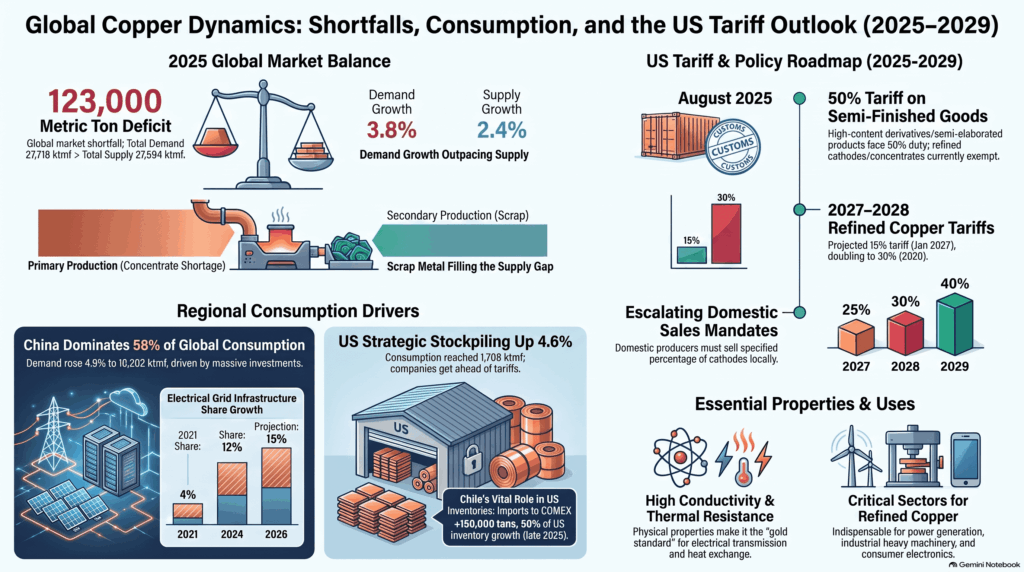
The global refined copper market ended 2025 with a deficit of 123,000 metric fine metric tons (ktmf). During this period, global demand grew by 3.8% to reach 27,718 ktmf. This increase outpaced the growth in total supply, which reached 27,594 ktmf after rising by 2.4%.
Global Demand for Refined Copper
China consolidated its position as the largest consumer of the metal, accounting for 58% of the global market. Its demand increased by 4.9% to reach 16,202 ktmf. Consequently, this growth was driven by increased investment in several key sectors:
- Electric power grids: This segment’s share of consumption for the energy transition grew from 4% in 2021 to 12% in 2024, with a projected 15% by 2026.
- Renewable energy and mobility: There was accelerated integration of clean energy sources and the electric vehicle ecosystem.
- Cutting-edge technology: The expansion of infrastructure for data centers and artificial intelligence drove consumption.
The United States Boosts Its Reserves in Anticipation of Possible Tariffs
Second, the United States increased its consumption by 4.6%, reaching 1,708 ktmf. This trend combined structural demand with strategic stockpiling. This stockpiling was a response to the possible imposition of tariffs under Section 232.
Likewise, imports of refined copper from Chile to the COMEX exchange grew by more than 150,000 metric tons through November 2025. In fact, Chile accounted for more than 60% of this increase in COMEX warehouse inventories.
Concentrate shortages limit primary production
On the supply side, refined production broke down into two main components:
- Primary production: Reached 23,579 ktmf, representing a 2.7% increase.
- Secondary production (scrap): Totaled 4,015 ktmf, with a slight increase of 0.7%.
In conclusion, the tight supply of concentrates limited the growth of primary refining. As a result, the industry was forced to turn to scrap as an alternative feedstock to sustain production.
U.S. Tariffs
Effective August 1, 2025, the United States imposed a 50% tariff on U.S. imports of semi-finished copper products and copper-rich derivatives. However, refined copper—including cathodes, concentrates, and scrap—was exempt from this tariff.
At the same time, the U.S. government has indicated that, by mid-2026, it will reassess the possibility of imposing a 15% tariff on refined copper starting in January 2027, which would increase to 30% in 2028.
In addition, the U.S. Secretary of Commerce was instructed to establish a requirement that 25% of domestically produced copper cathodes and concentrates be sold on the domestic market in 2027. This percentage could rise to 30% in 2028 and to 40% in 2029.
Key Properties and Uses of Copper
Copper is notable for its excellent ability to conduct electricity and heat—properties that define its fundamental industrial applications.
Refined copper is indispensable in various strategic sectors:
- Electric power sector: It is used in the generation and transmission of electrical power.
- Industrial sector: It is an essential component of industrial machinery.
- Consumer goods: It is integrated into consumer products with electrical and electronic components.