
Section 232 automotive tariffs are applied at a rate of 25% on imports of motor vehicles. Additionally, they will take effect in April 2025.
These tariffs do not apply to vehicles that comply with the United States-Mexico-Canada Agreement (USMCA) and contain U.S. components.
Section 232 automotive tariffs
A 25% tariff is also imposed on certain auto parts, effective as of May 2025. However, there are exceptions for auto parts that comply with the USMCA.
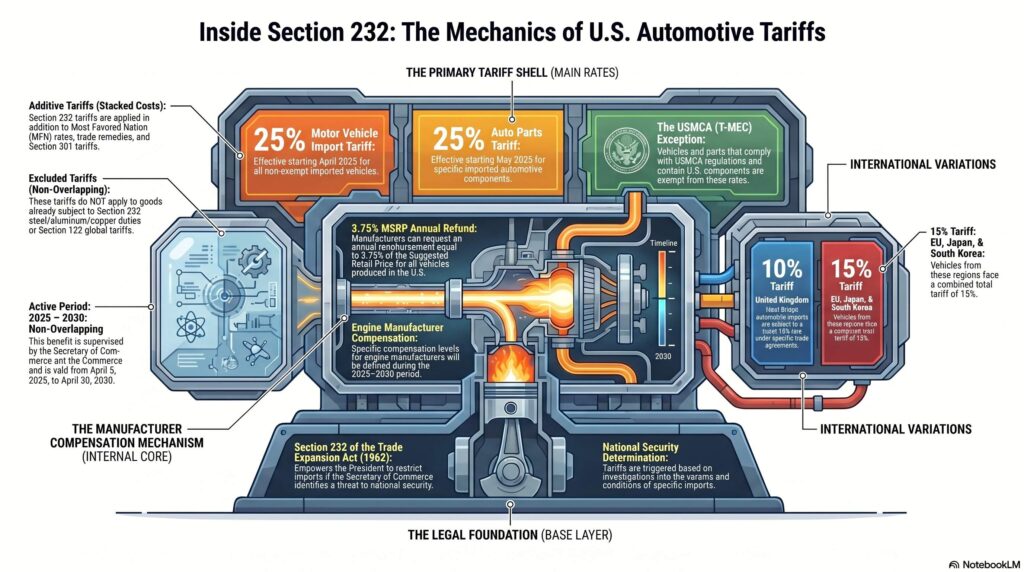
Under the trade agreement between the United States and the United Kingdom, most imports of British automobiles are subject to a 10% tariff. In comparison, vehicles from the European Union, Japan, and South Korea face a total tariff of 15%.
Section 232 of the Trade Expansion Act of 1962 empowers the president to restrict imports or negotiate with trading partners. This occurs if, following an investigation, the Secretary of Commerce determines that the volume or conditions of such imports pose a threat to national security.
Additional Regulations
According to an analysis by the U.S. Congress, the following U.S. tariffs do not apply to goods subject to Section 232 automotive tariffs:
- Other Section 232 tariffs (e.g., steel, aluminum, copper).
- Temporary global tariffs under Section 122 of the Trade Act of 1974.
Unless otherwise agreed, Section 232 automotive tariffs are in addition to:
- Most-favored-nation (MFN) tariffs.
- Trade remedy measures.
- Tariffs under Section 301 of the Trade Act of 1974.
The Trump Administration implemented a compensation mechanism for auto parts tariffs (to be reviewed in October 2025). Under this scheme, manufacturers may annually request a refund equivalent to 3.75% of the manufacturer’s suggested retail price (MSRP). Furthermore, it applies to all their vehicles produced in the United States.
This benefit, overseen by the Secretary of Commerce, will be in effect from April 5, 2025, to April 30, 2030. During that period, compensation for engine manufacturers will also be determined.