

The La Gloria-Colombia Highway in Nuevo León represents a key link in the diversification of logistics risks in Mexico.
Building this highway was “a priority for logistics, transportation, and security,” said Betsabé Rocha, Nuevo León’s Secretary of Economy.
Logistically, the route directly connects the interior of Nuevo León with the Colombia Border Port without passing through Tamaulipas. This optimizes transit times, reduces operating costs, and accelerates the flow of cross-border freight.
Diversification of Logistics Risks
Rocha noted that this highway was finally built after more than 40 years in the planning stages. With the new highway, a large portion of truck traffic now passes through the Colombia border crossing rather than the one in Nuevo Laredo, Tamaulipas.
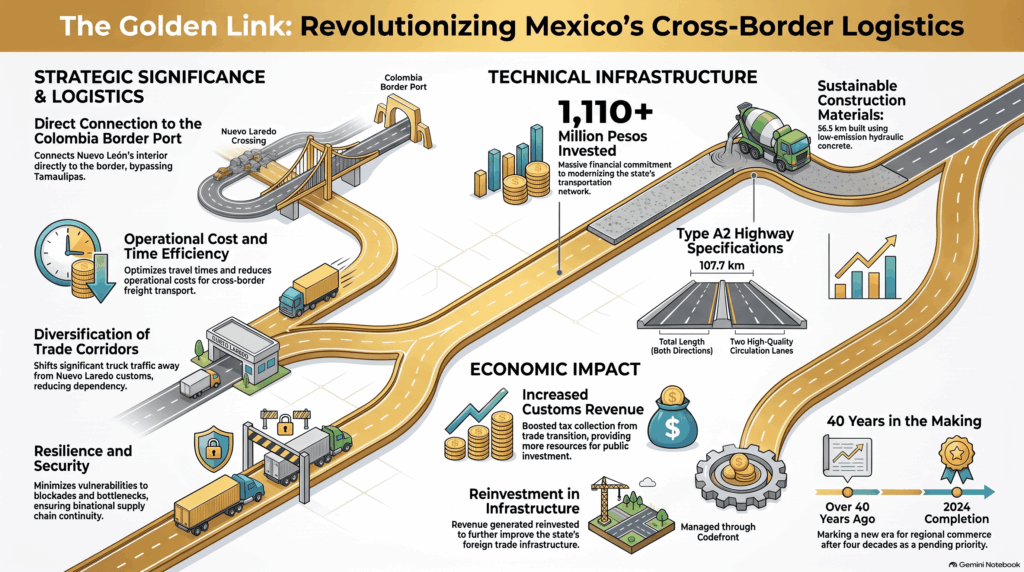
From a geopolitical perspective, the highway diversifies trade corridors by reducing dependence on Nuevo Laredo. In turn, it minimizes vulnerabilities to blockades, security incidents, or bottlenecks. As a result, this supports, to a certain extent, the resilience and continuity of the region’s binational supply chains.
“Since we didn’t have a direct connection, you obviously had to take a detour through Tamaulipas to cross into the United States,” Rocha added.
On Monday, the official participated in a press conference during which it was announced that the 32nd Mexican Foreign Trade Congress will be held in Monterrey, Nuevo León, from October 27 to 29, 2026, with Italy participating as the guest country.
Customs Revenue
With an investment exceeding 1,110 million pesos, the A2-class highway has a total length of 107.7 km (in both directions), including 56.5 km of new road built with low-emission sustainable hydraulic concrete and featuring two traffic lanes.
Rocha noted that the new highway has increased revenue. This translates into greater tax revenue for the state. In addition, it becomes a source of funds to be allocated toward improving the state’s logistics infrastructure.
“We can generate revenue for the state and continue to support the infrastructure essential for foreign trade,” he said.
Scheduled for completion in 2024, the highway will increase revenue from usage fees at the Colombia International Port (whose infrastructure and trust fund are partially administered by the state through Codefront).