
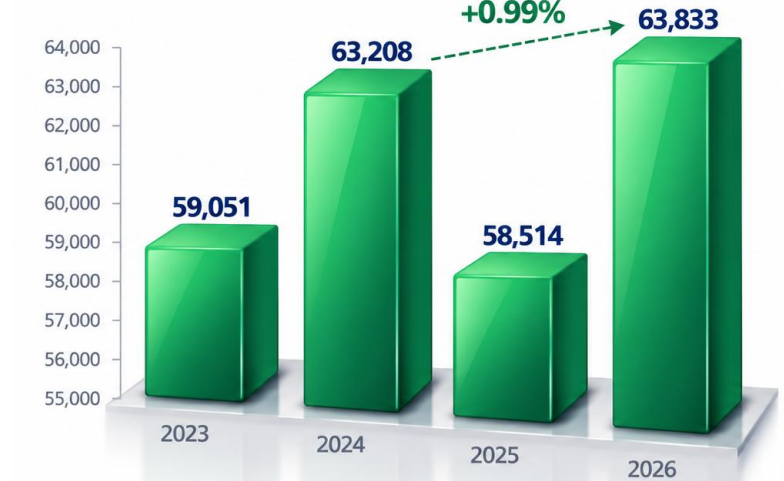
The Mexican auto parts industry reached a production value of 63,833 million dollars in the first half of 2026, a year-over-year increase of 9.1 percent.
According to estimates by Gentex Corporation, global light-duty vehicle production will fall by about 2% year-over-year during the third quarter of 2026 and by 3% for the full year. For 2027, the company forecasts a stabilization in production levels.
Mexico primarily produces electrical parts, which lead the market with a 19.5 percent share. These are followed by transmissions and clutches (9.5 percent), fabrics and carpets (9.2 percent), engine parts (8.1 percent), and gasoline engines (6.2 percent).
Mexican Auto Parts Industry
During the first half of 2026, Coahuila led auto parts production with 15.8%. It was followed by Guanajuato (13.5%), Nuevo León (13.2%), Chihuahua (8.5%), and Querétaro (8.0%). Together, these five states accounted for the majority of the sector in the country.
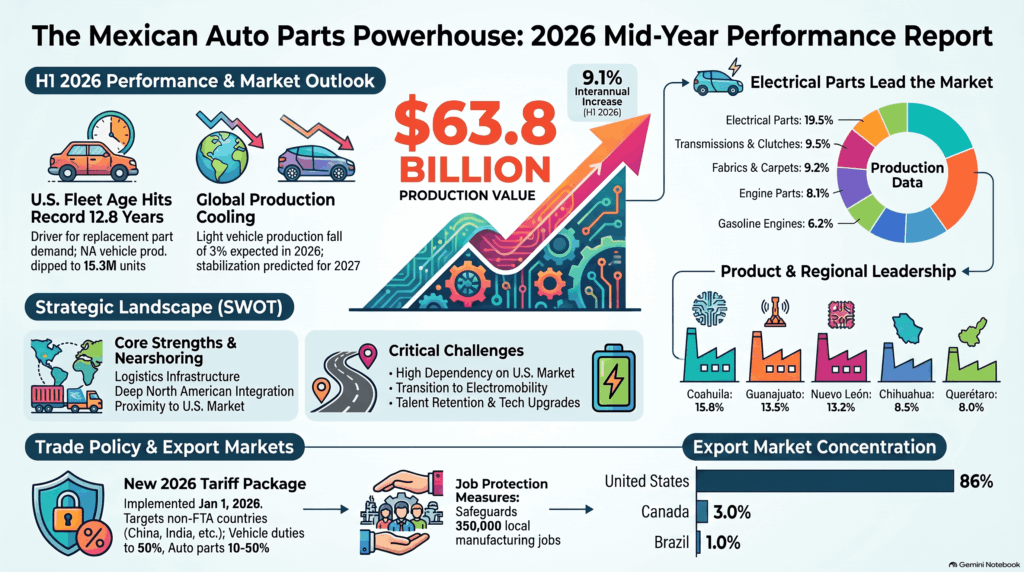
The Mexican auto parts industry stands out for its integration with North America, broad manufacturing base, proximity to the U.S. market, production specialization, export capacity, and ties to global manufacturers. Additionally, it combines industrial expertise, diversified suppliers, logistics infrastructure, and opportunities associated with nearshoring.
Conversely, its main challenges include dependence on the U.S. market, uncertainty regarding rules of origin and tariffs, a pause in new investments, the transition to electromobility, input costs, the need for technology, and retaining specialized talent.
Regional Automotive Production
Light-duty vehicle production in North America totaled 15.3 million units in 2025, slightly below the 15.4 million reported in 2024.
In contrast, sales in the United States grew 2% year-over-year to reach 16.3 million vehicles. At the same time, the average age of the U.S. vehicle fleet reached an all-time high of 12.8 years—surpassing the 2024 record—which will drive vehicle replacement.
Additionally, the 25% tariff imposed in 2025 on imports of automobiles and auto parts is expected to stimulate demand for locally manufactured models.
Tariff Policy
The Tariff Package implemented by the Ministry of Economy on January 1, 2026, imposes tariffs on imports from China, South Korea, India, Brazil, and Indonesia. It applies to all countries with which Mexico does not have free trade agreements. The measure covers key sectors such as automotive, textiles, and steel to protect 350,000 local jobs.
Under the proposed changes, import tariffs on cars rose to 50 percent, up from a range of 15 to 20 percent, and those on auto parts rose to a range of 10 to 50 percent, up from a range of 0 to 35 percent.
During the first half of 2026, Mexico’s auto parts exports were primarily destined for the United States, which accounted for 86.0%. The remainder went to Canada (3.0%), Brazil (1.0%), South Korea (0.8%), and China (0.7%).