
Free trade under the USMCA was undermined during the second term of U.S. President Donald Trump.
In a letter sent on August 6, 2026, a group of 168 Republican members of Congress asked White House Trade Representative Jamieson Greer to “streamline tariff structures to strengthen regional competitiveness in the global market.”
Free Trade Under the USMCA
Trade was fully liberalized under the North American Free Trade Agreement (NAFTA) on January 1, 2008, when the last remaining tariffs and quantitative restrictions were eliminated, in accordance with the agreement’s phase-out schedule.
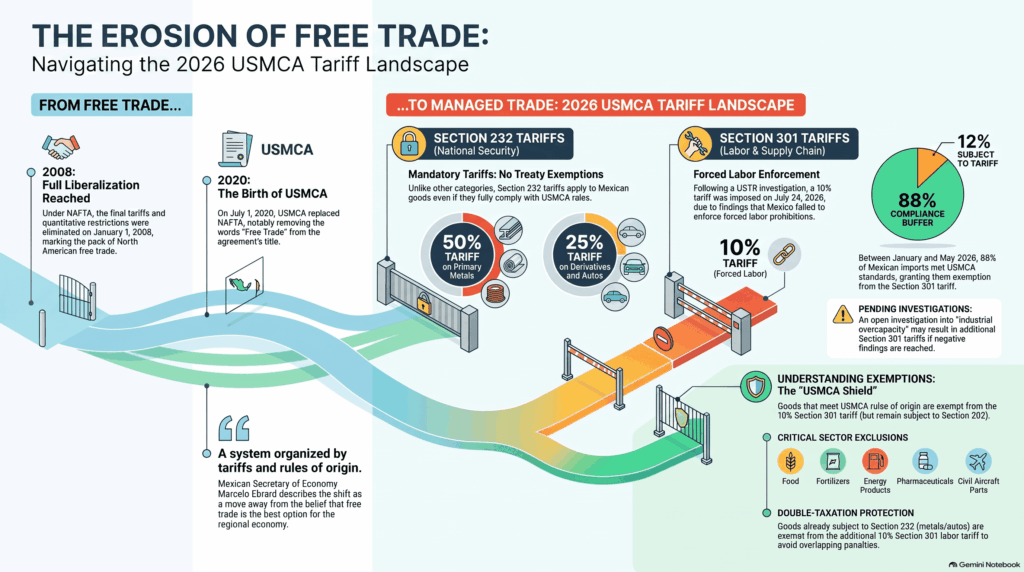
After 26 years and 6 months in effect, NAFTA was replaced by the USMCA on July 1, 2020, at the initiative of Trump, who removed the words “free trade” from the treaty’s title.
“I believe the main difficulty we face is that the U.S. government does not consider free trade to be the best option. In other words, we are dealing with a trade system organized by the United States based on tariffs and rules of origin,” commented Marcelo Ebrard, Mexico’s Secretary of the Economy, on April 23, 2026.
Current Tariffs on Mexican Products
Certain imports from Mexico to the United States are subject to tariffs at varying rates. These tariffs are imposed under Section 232 of the Trade Expansion Act of 1962. They apply to automobiles, automotive parts, steel, aluminum, and copper.
In February 2026, the Supreme Court struck down the tariffs imposed in 2025. Subsequently, the government launched two investigations under Section 301 of the Trade Act of 1974.
These investigations cover dozens of economies. They examine industrial overcapacity and the use of forced labor in supply chains.
The U.S. Trade Representative concluded that Mexico had not enforced the ban on forced labor. Consequently, it imposed a 10% tariff on Mexican imports. This tariff took effect on July 24, 2026. However, goods that comply with the USMCA are exempt.
Between January and May 2026, 88% of imports from Mexico to the U.S. were in compliance with the USMCA.
Regulated Trade
The investigation into industrial overcapacity is still ongoing. If it yields negative results, there could be additional tariffs on products from Mexico.
“Therefore, we are fully aware that this is the Trump administration’s priority,” Ebrard added that same day (…) When we talk about renewing a free-trade agreement, this is clearly the main issue. It’s not about anything specific, but rather about two different ideas.”