
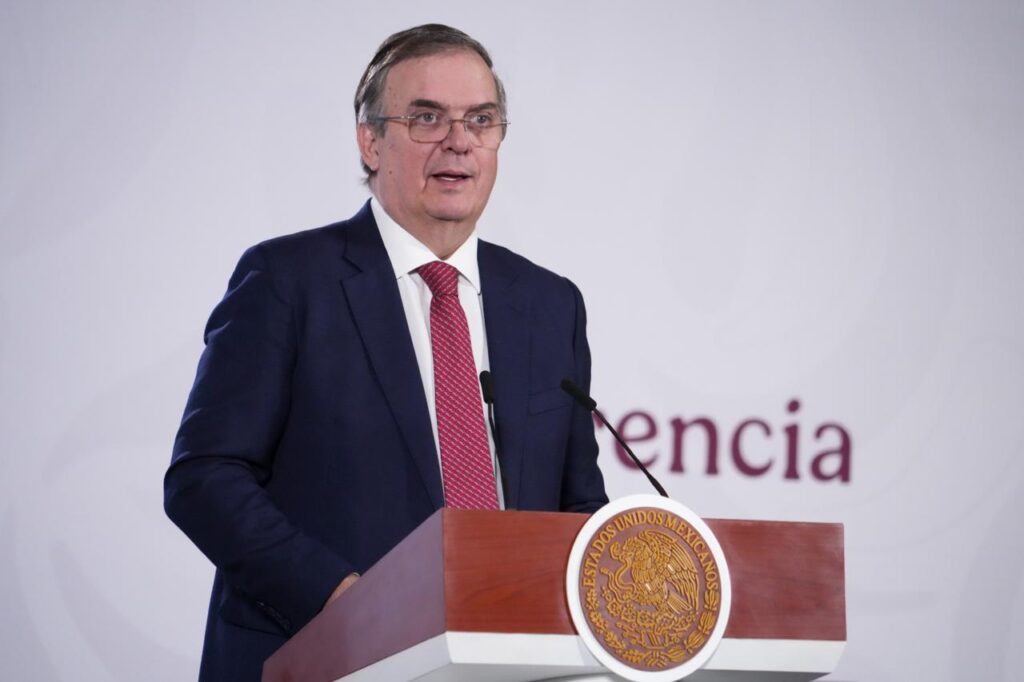
Economy Secretary Marcelo Ebrard asked the United States to treat Mexico more favorably in the ongoing investigation into Section 301 tariffs related to “excess capacity,” offering a quid pro quo in the USMCA negotiations.
This offer represents a continuation of both countries’ negotiating tactics: the United States secures the removal of non-tariff barriers or the resolution of trade irritants, and in exchange, Mexico receives somewhat better treatment under President Donald Trump’s tariff policy.
Quid pro quo in the USMCA negotiations
Mexico and the United States agreed to hold the fourth round of bilateral USMCA negotiations in the United States in early September to advance the USMCA review.
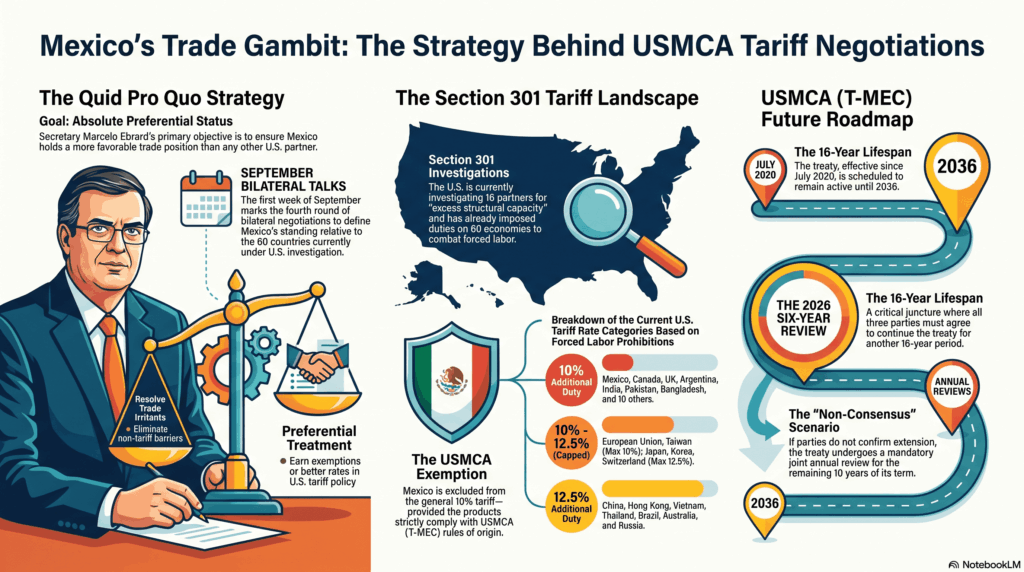
“The next round of talks with the United States is scheduled for the first week of September, which will allow us to gain clarity on the dynamics between Mexico and the other countries. Because what we want to achieve is for Mexico’s position to always be given preferential treatment compared to any other country,” said Ebrard.
Last Friday, the United States imposed tariffs ranging from 10% to 12.5% on 60 economies. Mexico was included with a 10% rate. These measures aim to combat forced labor.
In addition, the new tariffs replace the temporary 10% global tariff established by Donald Trump. That tariff expired early Friday morning.
It is worth noting that Trump had imposed this tariff on a temporary basis in February. This occurred after the Supreme Court struck down most of his global tariffs.
However, Mexico was exempted from the new 10% tariff. This exemption applies only to products that comply with the rules of the USMCA.
Excess Capacity
Meanwhile, the United States is conducting another investigation that also includes Mexico. The goal is to determine whether 16 trading partners have structural excess capacity and production in manufacturing sectors.
“That’s why the round was scheduled for the first week of September—with the aim of addressing, finalizing, or concluding many agreements with the United States. But we already have a clear picture of the situation in the other countries. Remember that in the Section 301 investigation, the first phase involved 60 countries, and the second phase involves 16 countries,” Ebrard added during a press conference in Mexico City.
USMCA Outlook
The USMCA entered into force on July 1, 2020. Its initial term is 16 years, through 2036. In addition, it is reviewed every six years.
However, if there is no consensus during the review, the treaty remains in effect. That said, it will automatically expire in 2036 if it is not renewed.
On the other hand, if all three parties agree to continue it, it will remain in effect for another 16 years. However, if any party does not confirm its desire to extend the agreement, a joint annual review will be conducted during the remaining decade.