

Mexico’s fiscal restrictions prevent the federal government from granting broad-based industrial subsidies, according to the Ministry of Economy.
This argument was raised as part of the investigation being conducted by the U.S. Trade Representative into structural overcapacity and production in the manufacturing sectors under Section 301.
Mexico’s Fiscal Restrictions
According to the Ministry of Economy, Mexico does not maintain broad-based or non-market-based industrial subsidy schemes or other government measures designed to artificially expand productive capacity.
Data from the World Trade Organization (WTO) indicate that Mexico provides significantly lower levels of subsidies than major WTO members, including the United States.
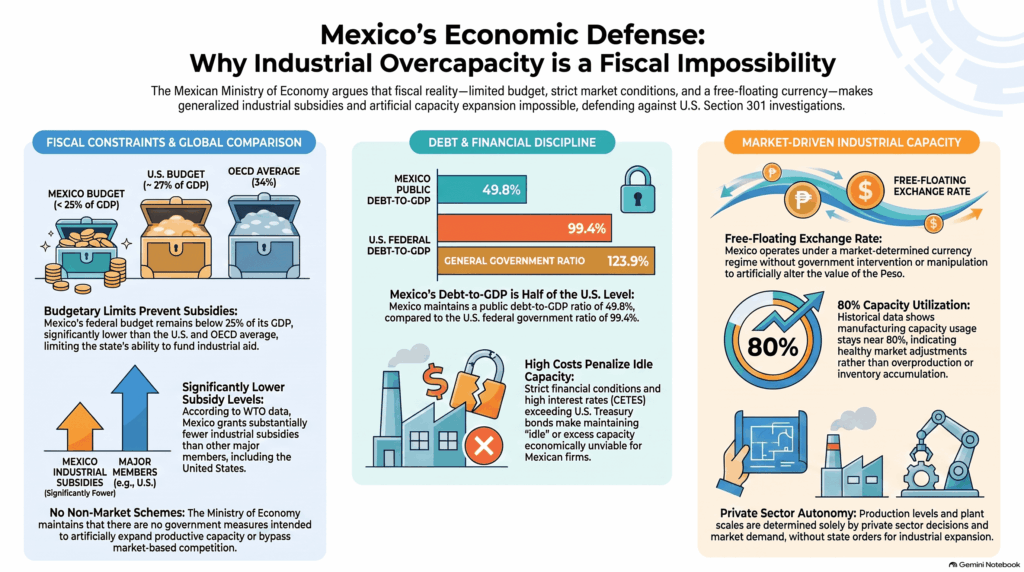
This is largely due to Mexico’s fiscal constraints. Mexico’s federal budget remains below 25% of GDP, compared to approximately 27% in the United States and an average of 34% among OECD countries.
The USTR launched new Section 301 investigations focusing on structural overcapacity in the manufacturing sectors and forced labor practices.
On the one hand, the investigations into forced labor resulted in additional Section 301 tariffs of 10% or 12.5% on imports from 60 economies—subject to certain product exemptions—effective July 24, 2026.
On the other hand, the investigations into structural overcapacity could result in additional country-specific tariffs, similar in scope to the taxes previously imposed under the IEEPA.
Below are three arguments presented by the Ministry of Economy:
Public Debt
Mexico’s public debt-to-GDP ratio (49.8%) is lower than that of the United States (99.4% for the federal government and 123.9% for the general government). Furthermore, financial conditions in Mexico are tighter. For example, the yield on CETES significantly exceeds that of U.S. Treasury bonds. Consequently, these conditions discourage maintaining idle capacity, as it represents a very high cost.
Exchange Rate
On the other hand, Mexico operates under a freely floating exchange rate regime. Under this system, market forces determine the value of the peso against the dollar without intervention by the Bank of Mexico or the government. Therefore, there is no exchange rate manipulation to artificially alter the peso’s value. Similarly, the government does not mandate industrial expansion or provide financial support to maintain overcapacity.
Industrial Capacity
Similarly, industrial production responds to private-sector decisions and market demand. In fact, there is no evidence of excess capacity, overproduction, or inventory buildup in the sectors under investigation. Historically, manufacturing capacity utilization has hovered around 80 percent, confirming market adjustments. Finally, the government does not interfere in private decisions regarding the scale of production facilities.