
Roberto Perosa, president of the Brazilian Association of Meat Exporting Industries (ABIEC), emphasized that Mexico is pursuing a smart trade policy.
ABIEC is the trade association that represents Brazil’s leading beef packers and exporters. It promotes the sector’s global positioning, competitiveness, market access, and quality.
ABIEC
Mexico produced 2,310,000 metric tons of beef in 2025, while its imports totaled 285,000 metric tons and its exports totaled 315,000 metric tons.
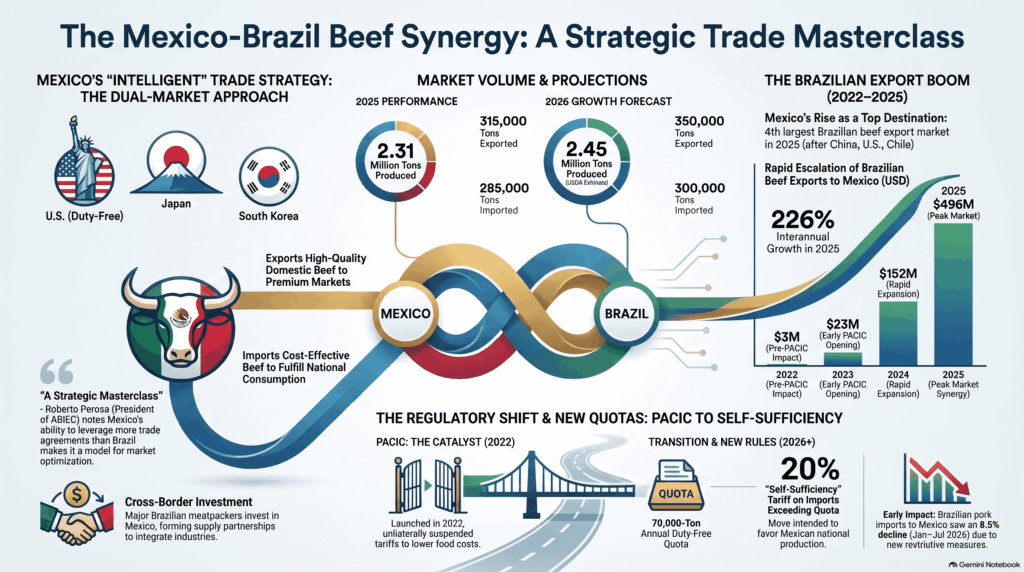
“Mexico has a very smart trade strategy. It has been exporting its beef to the United States by taking advantage of its duty-free access, so to speak, and importing Brazilian beef for domestic consumption,” said Perosa at a press conference held during the 2026 International Animal Protein Expo (SIAVS).
By 2026, the U.S. Department of Agriculture (USDA) estimates that Mexico will produce 2,450,000 metric tons, import 300,000, and export 350,000.
SIAVS is held every two years and is organized by the Brazilian Animal Protein Association (ABPA). It is the leading event in Brazil’s meat industry.
Brazilian Beef Exports
Mexico imported $496 million worth of Brazilian beef in 2025, a year-over-year increase of 226%. However, the end of a temporary tariff-elimination policy and the establishment of a tariff-free quota with a 20% tariff applied to volumes exceeding that quota contributed to the 8.5% year-over-year decline in Mexican imports of Brazilian pork from January through July 2026, bringing the total to $333 million.
“As for the plan for Mexico, there are already many Brazilian companies in our sector that are investing there. There are partnerships between large Mexican and Brazilian companies, as well as companies in the sector in Mexico that have partnered with Brazilian firms for supply,” said Perosa.
Mexican Trade Liberalization
Currently, Mexico applies an annual duty-free quota of 70,000 metric tons for beef (fresh, chilled, or frozen) from any country without a trade agreement. Beyond that limit, a 20% tariff applies. The quota remains in effect through the end of 2026.
“Mexico is a country that inspires us greatly, because it has trade agreements with many more countries than Brazil does. For example, it already has authorization to export to Japan, South Korea, and Turkey. So it exports what it produces—which is also high-quality beef—and ends up importing beef from Brazil to meet its domestic demand,” said Perosa.