

Brazil, the United States, and the European Union ranked as the top chicken meat exporters in 2025, according to data from the U.S. Department of Agriculture (USDA).
With 5,324,000 metric tons, Brazil took the top spot on the list, with year-over-year growth of 0.5%. Brazil marginally widened its lead over its two closest competitors.
While European Union exports fell by 0.2% (3,034,000 metric tons), foreign sales from the European Union declined by 1.2% (1,750,000 metric tons) on an annual basis.
Top Chicken Meat Exporters
In contrast, the other two largest exporters of this product recorded higher growth rates. Thailand exported 1,250,000 metric tons of chicken meat, an increase of 6.8 percent.
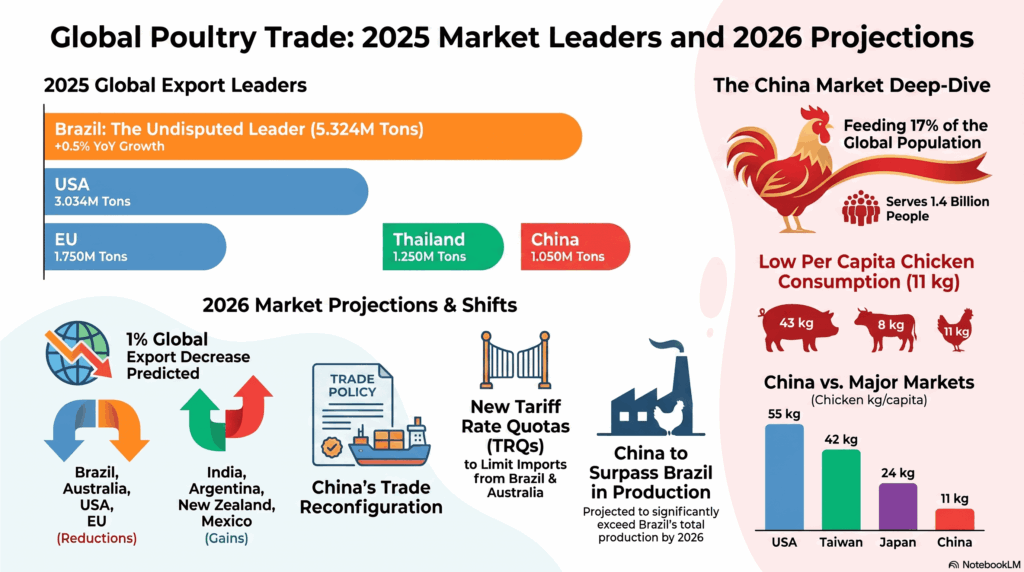
Showing even stronger momentum, Chinese exports surged 36.4%, reaching 1,050,000 metric tons.
The remaining exporters accounted for 2,159,000 metric tons, a year-over-year increase of 3.4 percent.
Projections for 2026
The USDA forecasts that global exports will decline by 1% in 2026. This will occur because reductions in Brazil, Australia, the United States, and the European Union will outweigh the increases recorded in India, Argentina, New Zealand, and Mexico.
In addition, a major reshuffling of global trade flows is expected. The reason? China, the world’s largest importer, will implement a series of tariff-rate quotas (TRQs) that will limit its imports, especially those from Brazil and Australia.
Chinese Market
China is the world’s second-largest producer of chicken meat, trailing significantly behind the United States and often on par with Brazil. However, Chinese production is projected to far exceed that of Brazil by 2026.
China’s massive production meets the consumption needs of its 1.4 billion people, who account for approximately 17% of the world’s population. Despite certain long-term changes in diet and lifestyle, chicken consumption in China remains relatively low: 11 kg per capita.
By comparison, per capita pork consumption is projected to be 43 kg and beef consumption 8 kg by 2025. Furthermore, chicken consumption in China is lower than in other countries, such as the United States (55 kg), Japan (24 kg), and Taiwan (42 kg).