

Canola trade has a key impact on Canadian exports and the U.S. economy, according to the Canola Council of Canada (CCC).
For context, the CCC is the national organization representing the Canadian canola industry’s value chain and represents approximately 40,000 canola farmers, along with processors, exporters, and technology developers.
Canola Trade
Canada ranked as the largest exporter of canola in 2025, with $3.8 billion. It was followed by Australia ($2.8 billion), Romania ($1.4 billion), and France ($1.1 billion).
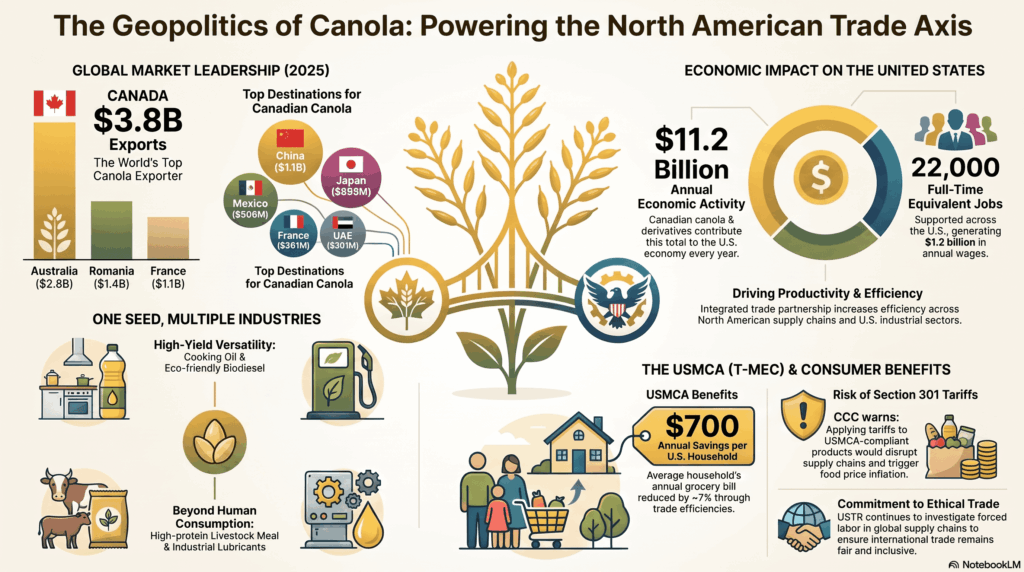
Globally, this crop stands out for its high yield. It is processed on a massive scale to produce edible cooking oil and eco-friendly biodiesel. The byproduct of extraction is used to produce protein meal for animal feed and industrial lubricants.
In 2025, Canadian canola exports were primarily destined for China, totaling $1,100 million. Other major destinations included: Japan (893 million), Mexico (506 million), France (291 million), and the United Arab Emirates (201 million).
The trend in Canadian canola exports to the world, in U.S. dollars, is shown below:
- 2018: 4,500.
- 2019: 3,200.
- 2020: 4,700.
- 2021: 5,100.
- 2022: 4,400.
- 2023: 4,500.
- 2024: 4,300.
- 2025: 3,800.
Tariffs
According to the CCC, canola grown in Canada, its products, and related activities contribute approximately 11,200 million dollars in economic activity to the United States annually.
The Canadian canola value chain directly and indirectly supports 22,000 full-time equivalent jobs in the United States and generates $1.2 billion in wages for U.S. workers each year.
This deeply integrated partnership also generates productivity and efficiency gains for North American supply chains and U.S. industry.
In addition, the CCC argued that the United States-Mexico-Canada Agreement (USMCA) offers quantifiable savings for U.S. consumers and families, reducing the annual cost of food for the average U.S. household by $700—equivalent to approximately 7% of their total grocery budget.
The USTR investigates the use of forced labor in global supply chains to identify labor violations, impose trade sanctions, restrict unethical imports, and ensure fair and inclusive international trade.
For all these reasons, the CCC warned the U.S. Trade Representative (USTR) that Section 301 tariffs on products that comply with the USMCA, including canola and its derivatives, would disrupt these supply chains and could drive up food prices in the United States.