
The United States has driven a restructuring of international trade, using tariff blocks as a geopolitical strategy, according to the Ministry of Economy.
The process of revising the United States-Mexico-Canada Agreement (USMCA) is part of a profound restructuring of global trade, driven by changes in the United States’ approach to trade policy.
Restructuring of International Trade
After decades of economic globalization, U.S. trade policy has changed course. The goal is clear: to reduce its trade deficit with the rest of the world. Washington argues that several countries benefited from its openness without offering reciprocity.
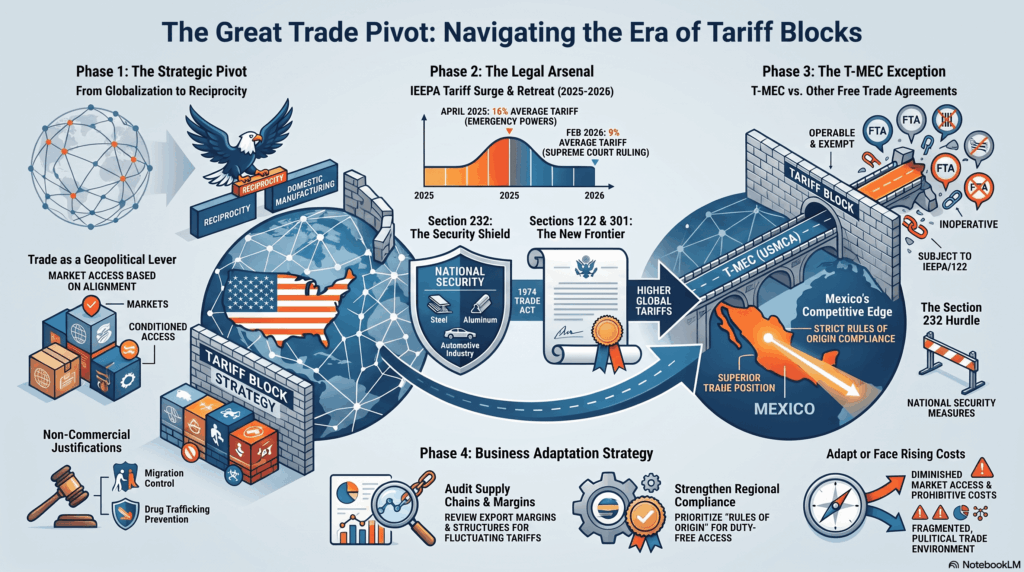
With this approach, the United States seeks to restore U.S. content in its manufacturing sector and rebuild lost industrial jobs, particularly in competition with Asia. In April 2025, it invoked the International Emergency Economic Powers Act (IEEPA) of 1977 to impose blanket tariffs. It did so on non-trade grounds, such as drug trafficking and immigration control.
Under that mechanism, it applied tariffs that varied by country, averaging 16 percent. However, in February 2026, the Supreme Court ruled that the law did not authorize the president to impose tariffs. Consequently, the administration suspended their application, and the average tariff dropped to 9 percent.
Even so, the United States continues to use other legal instruments to raise tariffs. Among them are Sections 122 and 301 of the Trade Act of 1974. Through these, it could largely reinstate the tariffs suspended under the IEEPA for all countries.
The Ministry of Economy outlined this context in a report on the USMCA review that it sent to the Mexican Congress on Wednesday.
Tariff Blocks
Furthermore, citing national security concerns, the U.S. government has imposed tariffs under Section 232 of the Trade Expansion Act of 1962. The measure seeks to protect sectors it considers strategic, such as steel, aluminum, and the automotive industry.
This process of trade restructuring is already having global effects. It ranges from the United States’ major allies to countries in Asia. And, increasingly, it is dividing the world into tariff blocs. This is both a geopolitical and a negotiating strategy. Washington uses it to make access to its market contingent on specific commitments from its partners.
USMCA
The United States has 14 free trade agreements. However, the trade measures implemented over the past 14 months have rendered them ineffective, with the exception of the USMCA. That agreement retains a general exemption. Section 122 does not apply to it, nor did the IEEPA at the time, although it is subject to tariffs under Section 232.
Today, due to its size and importance, Mexico retains greater trade advantages. This is primarily due to its compliance with rules of origin for exports to the United States. Compared to the rest of the world, this puts Mexico in a more favorable position.
Outlook
For affected companies, the priority is to anticipate changes in tariffs, rules of origin, and regulatory requirements. It is advisable to review supply chains, contracts, and export margins. Those who adjust their strategy quickly will be able to reduce risks and maintain competitiveness.
Looking ahead, the environment points toward greater trade fragmentation and decisions that are more political than technical. Companies that benefit should consolidate their position in North America, diversify their markets, and strengthen compliance. Those that fail to adapt will face higher costs and reduced access.