

The approval of the Modernized Comprehensive Agreement (MCA) between Mexico and the European Union (EU) will open up opportunities for Mexican and European companies.
On Wednesday, the European Parliament approved the MCA. For it to enter into force, the Senate of the Republic must now complete the necessary procedures.
Approval of the Modernized Comprehensive Agreement
Mexico and the European Union concluded negotiations on the Free Trade Agreement between Mexico and the European Union (EU-MX FTA) on April 28, 2020. Modernizing the trade agreement was a priority on Mexico’s trade agenda.
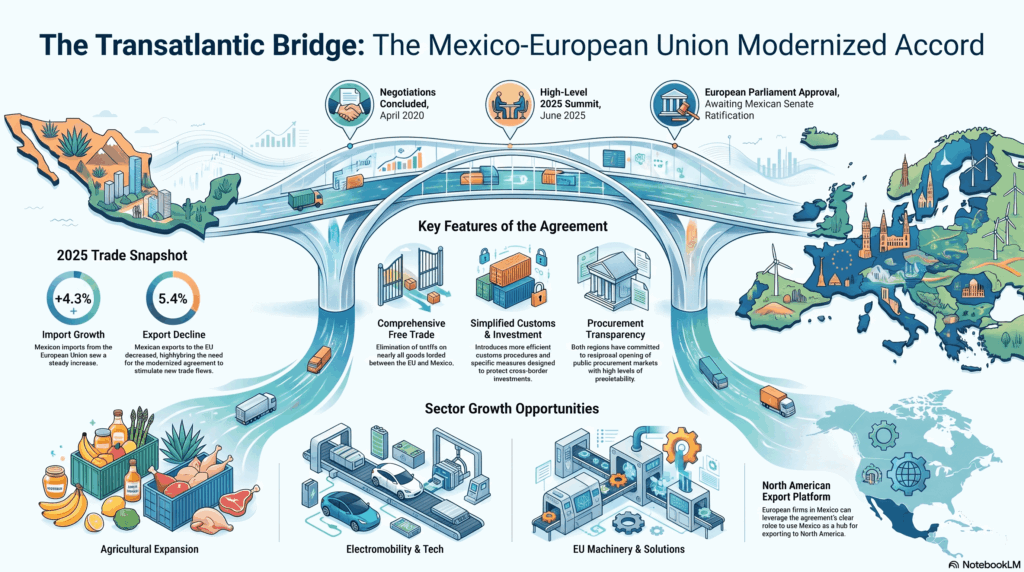
By 2025, Mexico’s imports to the EU had increased by 4.3%, while Mexico’s exports to the EU had decreased by 5.4%, compared to the previous year.
In this context, the European Commission’s Trade Commissioner and the Minister of Economy finalized the scope of the reciprocal opening of public procurement markets. As a result, they ensured a high level of predictability and transparency in the processes.
The EU-MX FTA includes free trade in nearly all goods between the EU and Mexico. It also features progressive standards on sustainable development, measures to protect investments, and simplified customs procedures.
In addition, in April 2024, during virtual meetings of the Special Committee on Intellectual Property and the Special Committee on Public Procurement, Mexico and the European Union discussed the implementation of intellectual property protection in both territories. They also discussed the mutual exchange of statistical information.
Business Opportunities
Furthermore, on June 17, 2025, during the 51st G7 Leaders’ Summit in Canada, President Sheinbaum met with the President of the European Council and the President of the European Commission. Together, they discussed updates to the trade agreement between Mexico and the European Union.
The approval of the agreement will open up concrete opportunities for the Mexican agricultural sector. Among the products with the best prospects are bananas, honey, asparagus, lemons, canned tomatoes, poultry, beef, and pork, as well as egg products and agave syrup.
There will also be significant opportunities for electric vehicles and batteries. This expands the scope for the automotive industry and for new value chains linked to electromobility, as well as for inputs and components with higher technological content.
Machinery and Technology
Companies based in the European Union will be able to increase their sales in the Mexican market, particularly in industrial goods, technology, machinery, and solutions for supply chains. These solutions integrate with the new trade framework.
Looking ahead, the agreement also benefits European companies with a presence in Mexico. They will have a stronger platform for exporting to North America. In addition, they can take advantage of clearer rules and participate in business related to transatlantic trade.