

The safeguard mechanisms in the CPTPP provide adjustment alternatives for affected industries under certain conditions. These are emergency measures permitted by the World Trade Organization (WTO). Imports of a product must increase to such an extent that they cause or threaten to cause serious injury to the domestic industry. The aim is to give the industry time to adjust.
Safeguard Mechanism
First and foremost, the standard TIPAT discipline regarding the imposition of safeguards between the Parties—referred to as “transitional safeguard measures” in the CPTPP—applies.
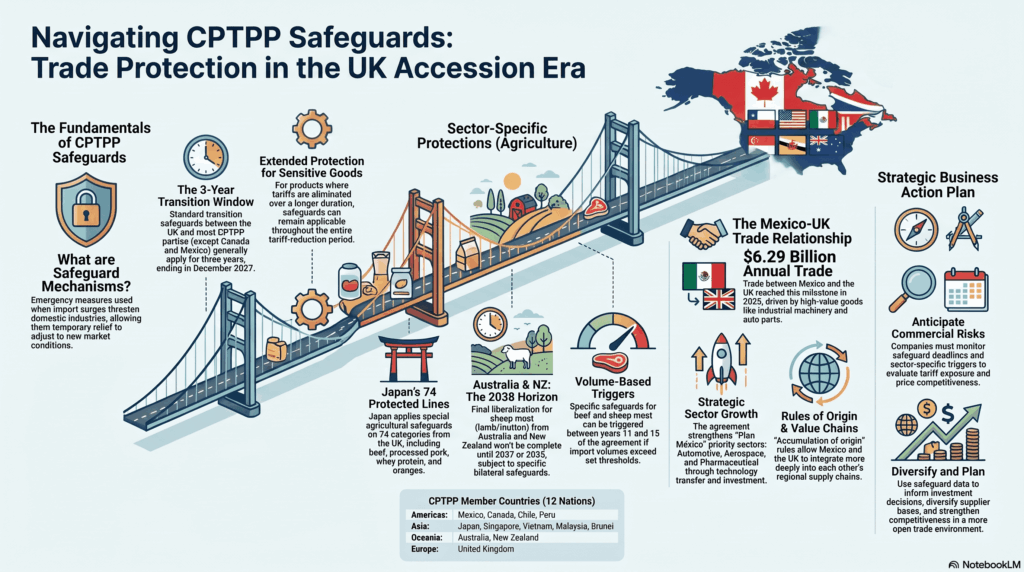
Consequently, safeguards imposed by the United Kingdom, or those imposed on products originating in the United Kingdom, may only be adopted during a three-year transition period beginning upon the entry into force of the Protocol between the respective Parties. This is in December 2027 for the United Kingdom and the CPTPP Parties, with the exception of Canada and Mexico.
For goods whose tariffs are phased out over a longer period, safeguards may be applied throughout the entire tariff elimination period (Article 4 of the Protocol).
Special Safeguards for Agriculture
According to a WTO report, Japan applies special safeguards for agricultural products to preferential imports from the United Kingdom in 74 product lines. These include beef, processed pork, whey protein concentrate, whey powder, oranges, and racehorses (Annex A of the Protocol).
The conditions for applying these measures remain those established in the CPTPP. The volume of imports under the Comprehensive Economic Partnership Agreement between the United Kingdom and Japan (CEPA) is also taken into account when calculating trigger levels.
Trade Liberalization
In general, liberalization will be completed by 2033. However, for Australia and New Zealand, the final liberalization of certain sheep meat products and sheep meat preparations (HS headings 0204, 0210, and 1602) will take place in 2037 or 2038. This will be in accordance with the timetable set out in the respective overlapping bilateral agreements.
In addition to the tariff treatment provided for in the Free Trade Agreements (FTAs) between the United Kingdom and Australia and between the United Kingdom and New Zealand, the treatment of the products in question is also subject to the provisions on bilateral safeguards. There are also special safeguards for agriculture regarding specific products set forth in these overlapping Regional Trade Agreements (RTAs).
During the final five years of the transition period for these products, Australia and New Zealand would only receive preferential access if the products are duty-free. In addition, the products must not be subject to a bilateral safeguard or a product-specific agricultural safeguard under the relevant RTA.
The general bilateral safeguard mechanism contained in both FTAs remains in effect until five years after the completion of the reduction or elimination of tariffs for that product. Product-specific safeguards are also established for beef (Australia and New Zealand) and sheep meat (Australia) between years 11 and 15 of the FTA. These may be applied when imports exceed a specific volume.
Decision-Making
For companies, understanding the safeguards under the CPTPP allows them to anticipate trade risks, assess tariff exposure, and devise timely responses. Its usefulness is not limited to protecting markets; it also helps plan investments, diversify suppliers, and strengthen competitiveness.
Turning this information into actionable intelligence involves monitoring deadlines, sensitive sectors, and the specific conditions of each agreement. Companies that incorporate these elements into their business planning can identify opportunities, reduce uncertainty, and make more accurate decisions in open markets.