
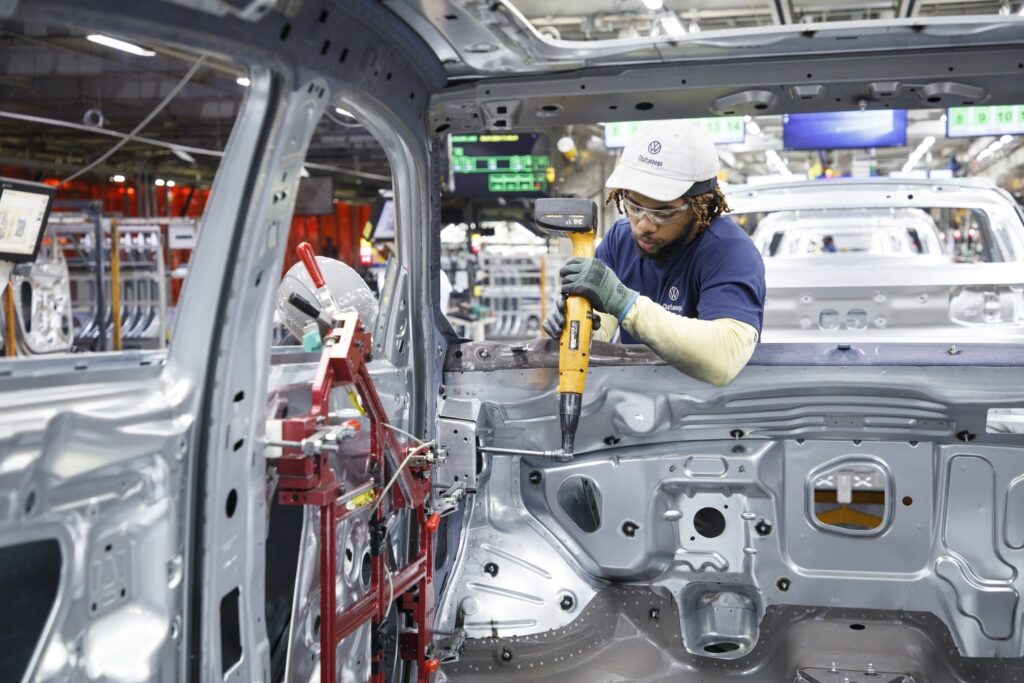
Volkswagen’s investments in the United States have totaled approximately $10 billion since 2018.
These investments by VWGoA have been made since the United States first imposed Section 232 tariffs on steel and aluminum that year.
VWGoA is the U.S. subsidiary of the Volkswagen Group. It operates brands such as VW and Audi. It manages manufacturing, marketing, and distribution in the United States.
Volkswagen Investments in the United States
The investment includes an $845 million expansion of the Chattanooga plant and the creation of more than 1,000 jobs with starting wages of $23.40 per hour for production and $32.60 per hour for skilled trades, plus a $3,000 sign-on bonus.
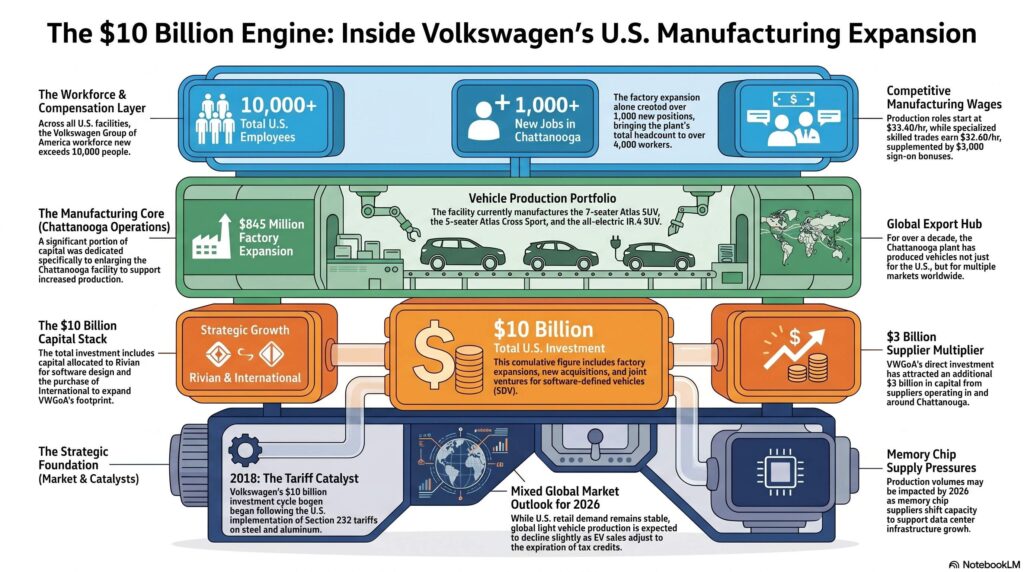
In total, the Chattanooga plant employs more than 4,000 workers. Furthermore, additional investments in Rivian for software-defined vehicles (SDVs) and the acquisition of International bring the total investment to $10 billion.
VWGoA’s own investments are multiplied by its suppliers’ investments in local production. This amounts to approximately $3 billion in new capital and manufacturing operations in and around Chattanooga.
For more than a decade, VWGoA has manufactured various vehicle models in Chattanooga for multiple markets around the world. Currently, this includes the 7-seat Atlas SUV, its 5-seat crossover variant, and the ID.4 electric crossover SUV.
The total number of VWGoA employees in the United States, across all its facilities, exceeds 10,000.
U.S. Market
For the full year 2026, S&P Global expects global light vehicle production to decline slightly compared to 2025.
According to Visteon Corporation, market conditions remain mixed across different regions of the world. In the United States, retail demand remains stable, although electric vehicle sales are expected to decline due to the recent expiration of certain tax credits.
Retail demand in Europe is also expected to increase slightly. On the other hand, retail demand in China is anticipated to decline marginally due to recent changes in government incentives.
In 2026, memory chip market conditions could create cost pressures and potentially impact industry production volumes. This is because memory suppliers’ capacity is increasingly being allocated to support the growth of data center infrastructure.
The impact of tariffs on the automotive industry remains uncertain, with the potential to increase production costs and affect future vehicle sales volumes.