
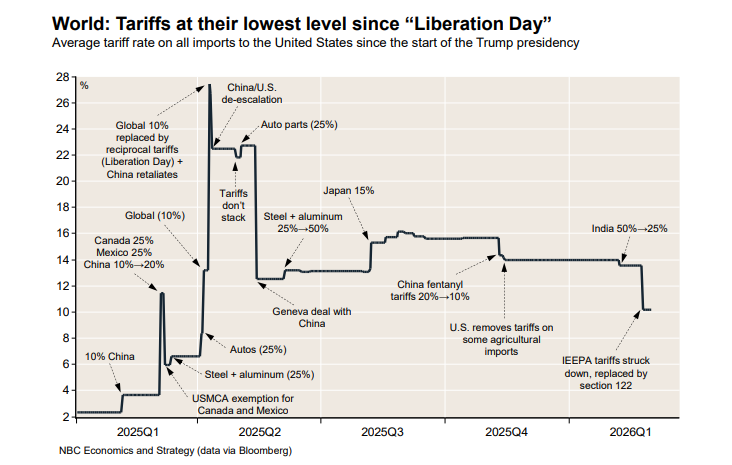
U.S. tariffs have reached their lowest level since Liberation Day. This was highlighted by Jocelyn Paquet in an article published by the National Bank of Canada.
When considering import duties at U.S. customs under Section 122 of the Trade Act of 1974, the Supreme Court’s decision to invalidate tariffs related to the International Emergency Economic Powers Act (IEEPA) has led to a reduction in the average tariff applied to goods entering the United States. As a result, it is currently at its lowest level since Liberation Day.
While this improvement does not completely change the situation, Paquet believes it should help stimulate global trade.
Evolution of Tariffs in the United States
Currently, Section 122 tariffs impose an incremental 10% ad valorem tariff on covered imports. Additionally, the Trump Administration has announced its intention to increase this rate to 15 percent.
Section 122 tariffs expire after 150 days unless approved by the U.S. Congress. However, the Trump Administration has announced plans to investigate trade practices in order to impose tariffs under other laws.
Consequently, there is no guarantee that tariff levels will decrease when the Section 122 authorization expires. Nor is there any guarantee that new or higher tariffs will not be imposed.
Review of the USMCA
The tariffs imposed on the People’s Republic of China, Mexico, and Canada under the IEEPA were declared unlawful by the U.S. Supreme Court on February 20, 2026. Although they were lifted, the Trump Administration has taken steps to replace them with new tariffs under other legal authorities, such as Section 122 of the Trade Act.
Considerable uncertainty remains regarding the future of U.S. trade policy and the implementation of new tariffs. This includes, among others, tariffs on products manufactured in the People’s Republic of China, Mexico, and Canada.
This includes the 2026 Joint Review of the United States-Mexico-Canada Agreement (USMCA), which could affect rules of origin and import restrictions in trade with Mexico.
Even before the formal review of the USMCA, Economy Secretary Marcelo Ebrard reported that Mexico and the United States have made progress in identifying sensitive issues in bilateral trade. The United States raised 54 issues of concern, and Mexico presented 12 points. Ebrard has called for the removal of tariffs on products from the steel and automotive industries.