
U.S. pork exports to China fell by 28.7% year-over-year in 2025, to $248 million. This marks the fifth consecutive year of decline.
The decline began from the $1.648 billion reached in 2020. That year, China drastically increased its pork imports. This was due to severe domestic shortages caused by African Swine Fever.
This deficit drove up global prices and positioned China as the leading destination for global exports, with foreign purchases totaling a record high of $11.878 billion that year.
Note: The above statistic considers only fresh, chilled, or frozen pork.
U.S. Pork Exports to China
According to the National Pork Producers Council (NPPC), although China has been an important market for U.S. pork in recent years, there are numerous restrictions on U.S. pork exports. Furthermore, the NPPC questioned whether these restrictions comply with international standards.
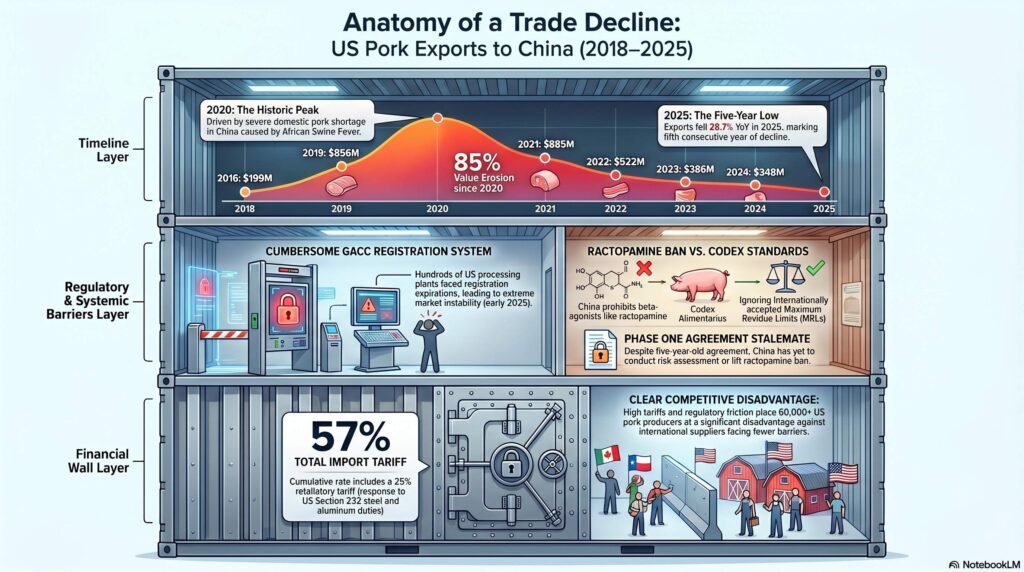
The NPPC informed the U.S. Trade Representative (USTR) that China’s cumbersome facility registration system continues to contribute to market instability. Consequently, this limits U.S. export potential.
In March 2025, more than 300 pork processing and cold storage facilities renewed their registrations for another five years. Earlier, in early 2025, two U.S. pork processing plants saw their registrations with the General Administration of Customs of the People’s Republic of China (GACC) expire. In addition, hundreds more were about to expire.
The NPPC also questioned China’s ban on the use of beta-agonists, such as ractopamine, rather than following the Maximum Residue Limits (MRLs) of the Codex Alimentarius (Codex). These MRLs are internationally accepted.
Retaliatory Tariffs
The Phase One Agreement between the United States and China required China to conduct a risk assessment of ractopamine in pork. However, after more than five years, the ban remains in place. Furthermore, no risk assessment has been conducted.
U.S. exports of fresh and frozen pork to China are also subject to 25% retaliatory tariffs. This is in response to the tariffs imposed by the United States under Section 232 on Chinese imports of steel and aluminum.
Current tariffs on U.S. pork exports to China stand at 57%, placing U.S. exports at a distinct disadvantage compared to imports from competing suppliers.
The NPPC represents 42 state producer organizations and the national and international interests of more than 60,000 U.S. pork producers.