
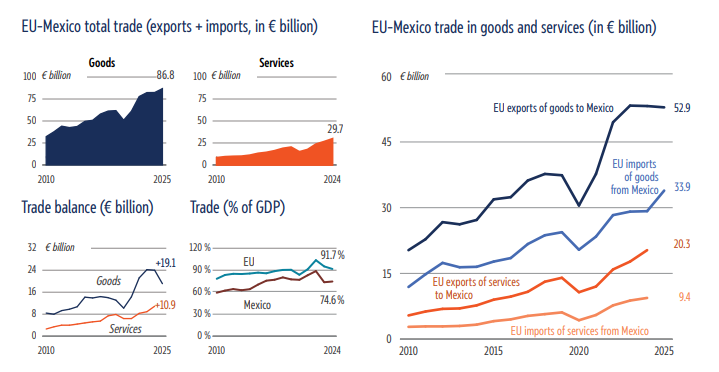
Trade between Mexico and the European Union (EU) reached a record high in 2025, according to data from the European Parliament. Furthermore, it has the potential to continue growing with the upcoming entry into force of the Interim Trade Agreement (ITA).
In 2025, trade between the European Union and Mexico, encompassing both goods and services, reached an all-time high of 86.8 billion euros in goods. Additionally, it reached 29.7 billion euros in services.
Trade between Mexico and the European Union
Among the leading Mexican companies exporting goods to the European Union are Cemex, Gruma, Sigma Alimentos, Grupo Bimbo, Orbia, and Nemak. In the services sector, Softek (IT) and entertainment multinationals such as Cinépolis stand out.
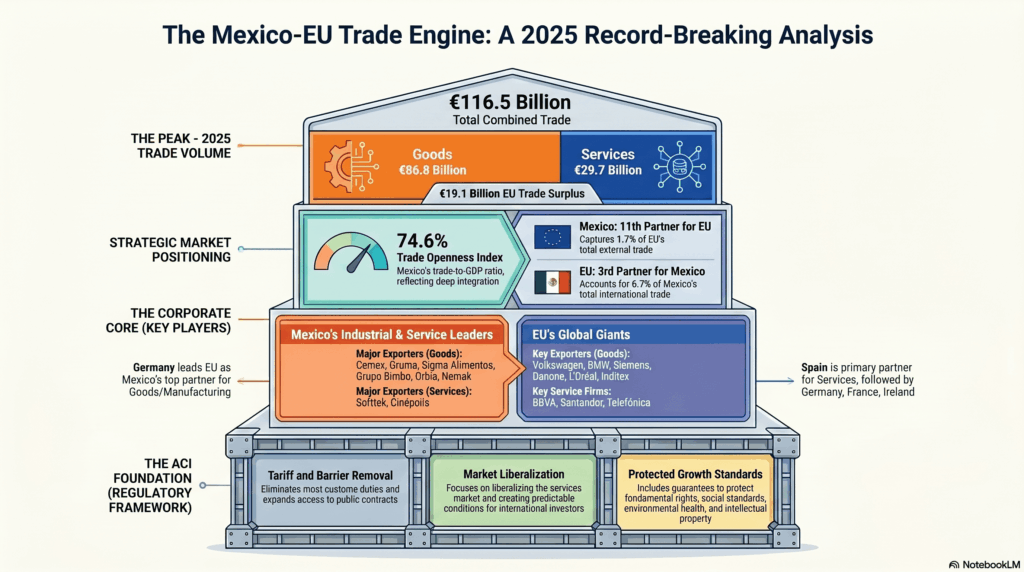
Conversely, the major European Union corporations exporting products and services to Mexico belong to the automotive, pharmaceutical, and technology sectors. Notable examples include Volkswagen, BMW, Siemens, Danone, L’Oréal, and Inditex. Also included are global service firms such as BBVA and Santander (financial) and Telefónica (telecommunications).
The EU and Mexico have reached an ambitious agreement, the CETA, in line with the most recent trade agreements. For example, agreements such as those signed by the EU with Canada, Japan, New Zealand, and Chile.
The ACI will open up new opportunities for trade and investment in both markets and boost employment in the EU. Among other things, the Agreement will eliminate most customs tariffs and expand access to public procurement. It will also liberalize the services market, provide predictable conditions for investors, and help prevent the illegal copying of EU innovations and traditional products.
The ACI also includes all necessary safeguards to ensure that economic benefits are not achieved at the expense of fundamental rights or social standards. Furthermore, it protects governments’ right to regulate, environmental protection, and consumer health and safety.
Trading Partners
The increase in imports of European goods from Mexico offset the slight contraction in eurozone exports. Consequently, this momentum reversed the trend of a growing trade surplus; however, the balance in favor of the European Union (EU) still amounts to 19.1 billion euros.
Position in International Trade and Economic Openness
On the global trade map, the exchange of goods reinforces the importance of both economies. This is evident in the following indicators:
- Strategic Partner of the EU: Mexico ranks as the European Union’s eleventh most important trading partner, accounting for 1.7% of the bloc’s total foreign trade.
- Key Market for Mexico: The EU remains Mexico’s third-largest trading partner, accounting for 6.7% of its total trade.
- Trade Openness Index: Mexico’s trade-to-GDP ratio stands at a robust 74.6%, a figure that reflects the high degree of integration of the Mexican economy into global value chains.
Leadership by Country: Trade in Goods vs. Trade in Services
The share of EU member states varies significantly depending on the sector analyzed:
- Trade in goods: Germany, driven by its strong export-oriented economy, has established itself as Mexico’s leading trading partner in the exchange of goods and manufactured products.
- Trade in Services: In this category, Spain leads as Mexico’s main trading partner, followed in importance by Germany, France, and Ireland.