

Trade agreements between Brazil and Mexico do not affect the United States, said Mauro Vieira, Brazil’s Minister of Foreign Affairs.
The Brazilian foreign minister set forth this position in a letter addressed to Jamieson Greer, head of the U.S. Trade Representative’s Office (USTR), as part of an ongoing Section 301 investigation.
Trade Agreements Between Brazil and Mexico
Vieira argued that the USTR’s suggestion that Brazil’s tariff preferences encourage the relocation of U.S. production to Mexico or India is unfounded.
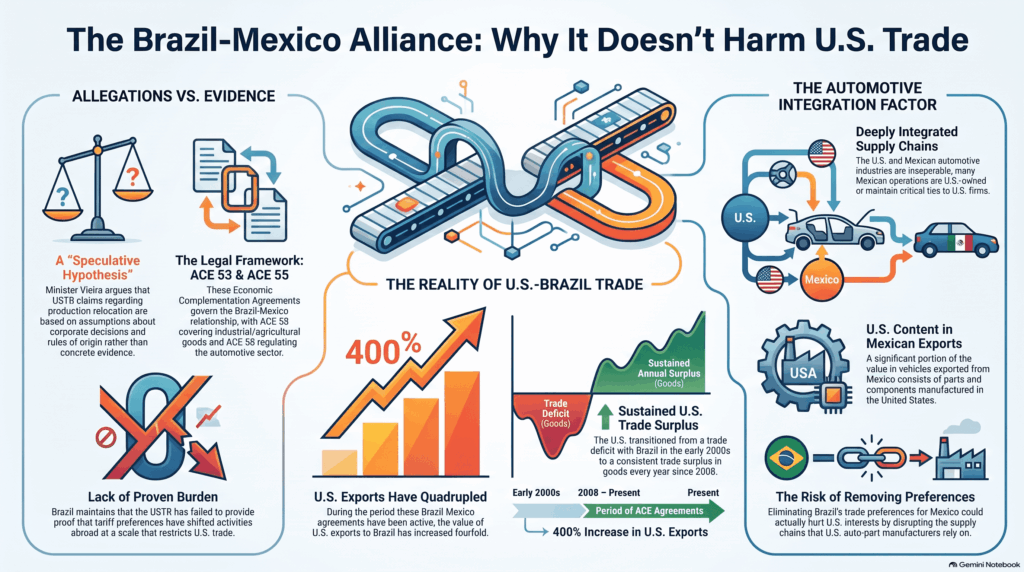
On this point, the Foreign Minister argued that this is a purely speculative hypothesis. “This suggestion is based on a series of mere assumptions regarding companies’ location decisions, the availability and supply of inputs, compliance with rules of origin, and the extent to which finished products would actually be redirected to Brazil under the relevant agreements,” he said.
In his view, the U.S. notification provides no concrete evidence that such a shift of activities abroad has occurred as a result of Brazil’s tariff preferences, much less that it has occurred on a scale sufficient to constitute a burden or restriction on U.S. trade.
Mexico and Brazil have in place the Economic Complementation Agreements ACE 53 and ACE 55. ACE 53 grants tariff preferences to various industrial and agricultural products, while ACE 55 regulates bilateral trade in the automotive sector.
Trade Balance
Vieira explained that Brazil’s relevant agreements with Mexico are part of a broader series of Economic Complementation Agreements and that U.S. exports to Brazil have increased significantly—quadrupling in value—during the same period that these agreements have been in effect.
Vieira also noted that the United States went from running a trade deficit in goods with Brazil in the early 2000s to achieving sustained trade surpluses in goods in subsequent years.
In fact, the United States has recorded a trade surplus in goods with Brazil every year since 2008.
“These facts substantially undermine the USTR’s attempt to portray Brazil’s tariff agreements with Mexico as a source of trade harm to the United States,” Vieira said.
Automotive Industry
For the foreign minister, this conclusion is even more compelling in the automotive sector. The relevant agreements between MERCOSUR and Mexico provide for preferential treatment for automobiles and auto parts. However, automotive production in the United States and Mexico is deeply integrated.
Many automotive operations in Mexico are owned by U.S. companies or have close ties to them. At the same time, Mexico is a key export market for U.S. auto parts and components.
A significant portion of the value of Mexican vehicles exported abroad consists of U.S.-manufactured content. Under these circumstances, according to Vieira, the USTR cannot simply assume that the preferences granted to Mexican automotive exports harm U.S. trade.
On the contrary, Vieira emphasized that eliminating these preferences could negatively affect U.S. commercial interests related to automotive production and supply chains in Mexico.