

The U.S. Department of Commerce (DOC) highlighted the opportunities for U.S. exporters arising from the transition to smart factories in Mexico.
A smart factory is a highly digitized and connected facility. In this environment, autonomous machines and systems optimize processes in real time using the Internet of Things (IoT), artificial intelligence, data analytics, and cybernetics. As a result, productivity and industrial innovation increase.
Smart Factories in Mexico
Although historically known as a destination for the assembly of finished products, Mexico is undergoing a major industrial transformation.
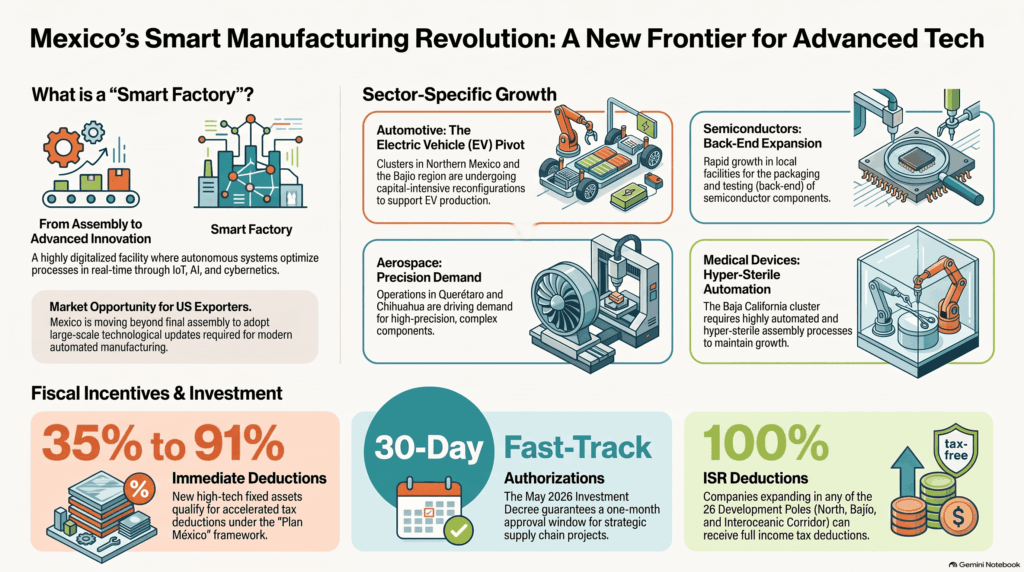
According to the DOC, Mexican manufacturing plants require large-scale technological upgrades to become modern, automated smart factories. This wave of technological modernization is creating an export market for U.S. suppliers of advanced manufacturing solutions.
Advanced Manufacturing
The following are some examples cited by the DOC related to the conversion of smart factories in Mexico.
The automotive sector in the northern and Bajío clusters is undergoing a capital-intensive transition toward the production of electric vehicles. This change requires new plant configurations and advanced modernization of its equipment.
At the same time, Mexico is rapidly expanding its local semiconductor packaging and testing (back-end) facilities. At the aerospace hubs in Querétaro and Chihuahua, operational expansion is driving demand for complex, high-precision components. Meanwhile, the medical device cluster in Baja California continues to grow. It requires highly automated and hyper-sterile assembly processes.
Tax Incentives
The Mexico Plan introduces accelerated tax incentives that allow manufacturers to claim immediate deductions ranging from 35% to 91% on new fixed assets for high-tech sectors. Additionally, the Fast-Track Investment Decree of May 2026 guarantees a 30-day authorization period for strategic projects in the supply chain.
Furthermore, the 26 Development Hubs established along the northern border, in the Bajío region, and along the Interoceanic Corridor offer income tax (ISR) deductions of up to 100% to companies that expand their local manufacturing capacity.