
The Office of the United States Trade Representative (USTR) reported that the United States seeks to simplify the USMCA’s rules of origin.
A report submitted by USTR Commissioner Jamieson Greer to the U.S. Congress indicates that the United States has an opportunity to simplify and optimize the rules of origin for the automotive sector. This would ensure that the benefits of the USMCA are more accessible, especially for small and medium-sized suppliers.
USMCA’s rules of origin
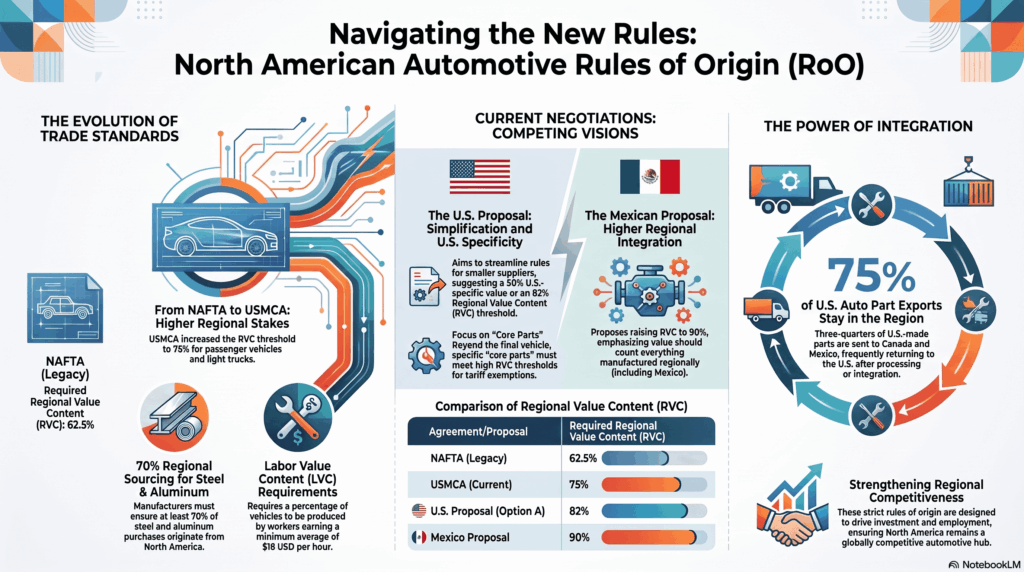
Mexico presented a counterproposal during the USMCA review: raising the Regional Value Content (RVC) from 75% to 90% for vehicles, countering the U.S. proposal to require that 50% of the value come from the U.S.; the U.S. also suggested an 82% RVC.
“We are seeking to ensure that even if these rules of origin increase to 90%, they remain regional; that is, that not only what is manufactured in the United States is counted, but also what is manufactured in Mexico,” said Mexico’s President Claudia Sheinbaum on Thursday.
The USMCA’s rules of origin for automobiles and auto parts require a specific amount of North American content in the final vehicle. This is necessary for the vehicle to qualify for duty-free treatment.
The USMCA raised the ROC requirements to 75% for passenger vehicles and light trucks. By comparison, the requirement was 62.5% under the North American Free Trade Agreement (NAFTA).
In addition, certain “key components” must meet high CVR thresholds. As a result, the entire vehicle can be eligible for the tariff exemption.
The USMCA also requires that at least 70% of a vehicle manufacturer’s steel and aluminum purchases come from North America. Finally, the USMCA introduced a new labor value content (LVC) rule requiring that a minimum percentage of each manufacturer’s qualifying vehicles be produced by employees earning an average wage of $16 per hour (or the equivalent in the applicable foreign currency).
Taken together, these new requirements aim to encourage greater investment in the production of automobiles and auto parts in the United States and North America.
Auto Parts Exports
The USMCA maintains its central role in the automotive industry, as preferential access for vehicles and auto parts has integrated North American production. Its rules of origin have driven investment, increased regional content, and created jobs, strengthening the sector’s competitiveness in North America.
Nearly 75% of U.S. auto parts exports are destined for Canada and Mexico; many return to the United States for processing or integration into vehicles. High levels of U.S. content in Canada and Mexico illustrate the benefits of the USMCA for integration.