

The United States leads global corn production and exports, supported by its fertile soils, advanced biotechnology, intensive mechanization, agricultural subsidies, and favorable climate.
The global map of exportable supply is rounded out by Argentina, Brazil, Russia, South Africa, and Ukraine, which focus on meeting the demand of major buyers such as Mexico, Japan, the European Union, South Korea, Egypt, and Southeast Asia.
In the case of China, its production of 307 million metric tons falls short of meeting domestic demand by approximately 6 percent.
Corn Production and Exports
The United States has consolidated its dominance in the market, accounting for 31% of global production and channeling nearly 20% of its harvest to foreign markets.
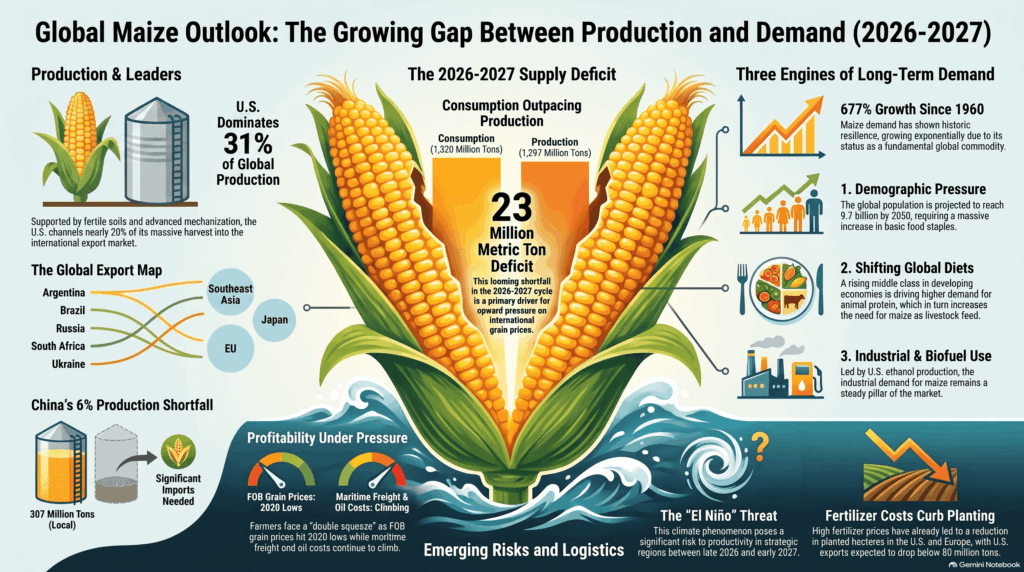
According to Teucrium Commodity Trust, a deficit of 23 million metric tons is projected in the global corn supply for the 2026–2027 agricultural cycle.
The USDA’s July 2026 projections indicate that global consumption will reach 1,320 million metric tons, exceeding global production of 1,297 million metric tons—a gap that is putting upward pressure on international corn prices.
In the long term, global corn consumption has grown by more than 677% since the 1960–1961 crop year. This structural trend is driven by three main factors:
Demographics: The U.S. Census Bureau’s projection that the global population will reach 9.7 billion by 2050.
Dietary Changes: The rise of the middle class in developing economies, which is driving up demand for animal protein and feedstuffs.
Industrial use: Sustained demand from the biofuel industry, led by ethanol production in the United States.
Despite temporary contractions resulting from economic shocks, health crises, or changes in trade policies, global demand has shown historic resilience, underpinned by its status as a fundamental staple commodity.
Global Grain Trade
FOB prices for grains and oilseeds remain at their lowest levels since late 2020, reducing profit margins for global producers.
Adding to this pressure on the agricultural sector is a rise in ocean freight and transportation costs, driven by high demand for ships, longer shipping routes, limited vessel availability, and rising oil prices.
For the 2026–2027 cycle, projections from the International Grains Council (IGC) anticipate a reduction in the global supply surplus and a contraction in international trade to around 205 million metric tons. This slowdown will affect export balances in Argentina, Australia, and the United States, while the Black Sea region and Canada are expected to perform well.
According to the ICC, the production and climate outlook for the 2026–2027 period is shaped by the following key factors:
Corn market: A surplus is forecast, with production nearing 1,300 million metric tons and trade volume at nearly 200 million metric tons. Industrial and fertilizer demand remains the sector’s main driver.
Adjustment in Planting Area: Rising fertilizer costs have reduced the number of hectares devoted to corn cultivation in the United States and Europe. As a result, U.S. exports are projected to fall below 80 million metric tons.
Climate risk: The El Niño phenomenon threatens productivity in key regions and for strategic crops, with its impact expected to be most severe between late 2026 and early 2027.