
The U.S. aerospace industry’s reliance on critical minerals could become an “Achilles’ heel” if tariffs in this sector are raised. This warning was issued by the Aerospace Industries Association (AIA).
With nearly 300 member companies, the AIA explicitly asked the U.S. Trade Representative (USTR) to limit tariffs on critical minerals and natural resources that are not mined in the United States or for which domestic capacity is insufficient.
Aerospace Industry’s Reliance
Reciprocal trade environments demonstrate how strengthening industry-focused policies can align with economic priorities. Furthermore, these policies can counteract barriers to foreign trade.
“Maintaining duty-free access to aerospace and defense parts and components, manufacturing, and critical inputs will ensure the long-term security and resilience of the aerospace and defense supply chain, as well as global market access and the competitiveness of U.S. exports,” urged the AIA.
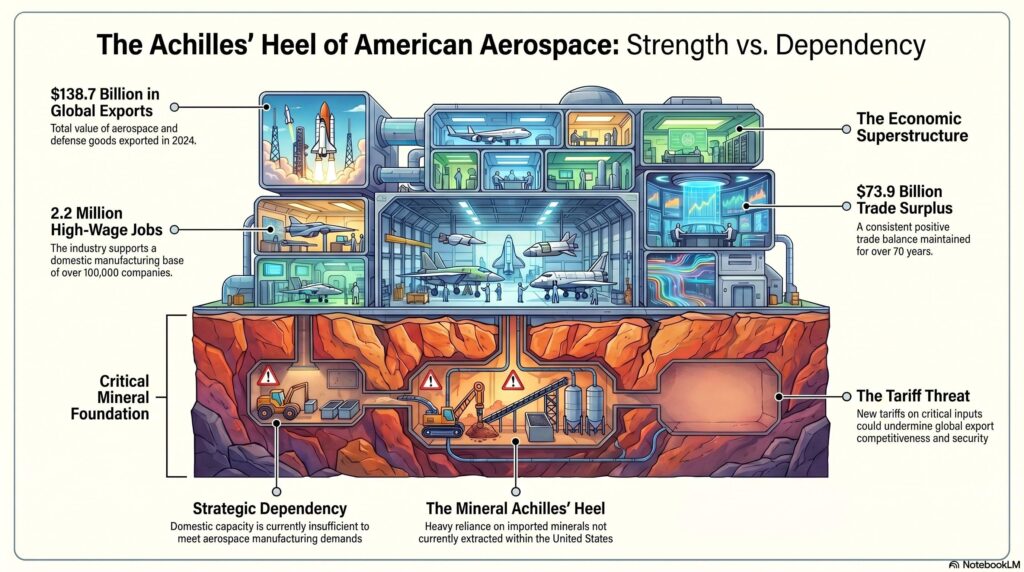
This perspective highlights the paradox of wanting to protect the U.S. aerospace industry. However, at the same time, the sector relies on strategic imports.
The AIA represents companies in the U.S. aerospace and defense industry, ranging from small suppliers to large original equipment manufacturers (OEMs). These companies span the entire supply chain and play a vital role in global trade.
This industry directly contributes to U.S. national security and economic growth, supporting a domestic manufacturing base of more than 100,000 companies and 2.2 million American workers.
Positive Trade Balance
In 2024, the industry exported $138.7 billion worth of goods and maintained a positive net trade balance of $73.9 billion.
For more than 70 years, the U.S. aerospace and defense industry has generated job growth, increased wages for American workers, and maintained a trade surplus.
According to the AIA, this industry generates well-paying manufacturing jobs in all 50 U.S. states. At the same time, it maintains leadership in global exports thanks to its reputation for innovation, safety, and reliability.