

The federal government plans to establish a lithium value chain in Mexico at some unspecified point in the future. It also faces limitations in designating lithium as a critical mineral.
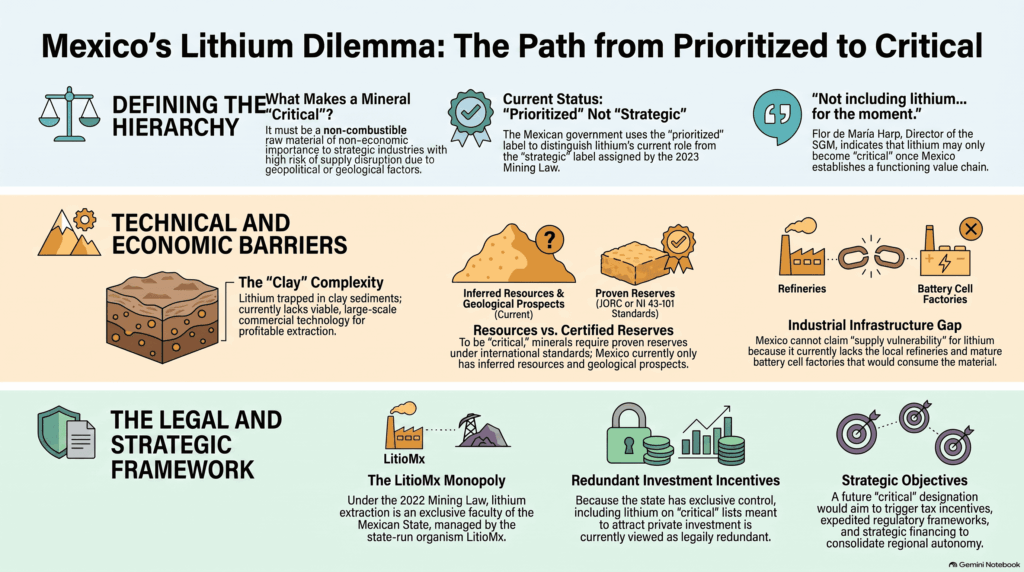
A critical mineral is defined as a non-combustible raw material of high economic importance to strategic industries. Its supply chain is highly vulnerable or at risk of disruption due to geopolitical, geological, commercial, or geographic concentration factors.
Lithium Value Chain in Mexico
Technically, the designation of lithium as a critical mineral is based on quantitative methodologies that assess the severity of the impact of a shortage, combined with the probability of global supply constraints, while considering the material’s substitutability and the country’s net dependence on imports.
During the Durango 2026 Mining Congress, the director of the Mexican Geological Service (SGM), Flor de María Harp, noted that each country determines—if it so chooses—its own list of critical minerals based on its needs and internal conditions.
“For the time being, we are not including lithium,” she said, referring to the list currently being compiled by the federal government. “Perhaps in the future, when Mexico has a lithium value chain, it may become a critical mineral.”
Internationally, multilateral organizations and governments classify these priority inputs using dynamic risk matrices. These lists align the availability of key minerals with the demands of the energy transition, electromobility, semiconductors, and defense.
Priority Mineral
“For now, it is being designated as a priority (lithium) to distinguish it from the ‘strategic’ label that the Mining Law assigned to it in 2023,” the official added.
For the business and mining sectors, this classification could redefine the investment landscape. It ensures tax incentives, streamlined regulatory frameworks, and strategic financing. Its primary goal is to mitigate bottlenecks and strengthen the self-sufficiency of regional supply chains.
Why Can’t Lithium Be Defined as a Critical Mineral in Mexico?
Mexican lithium is found primarily in clay sediments, as opposed to brines or hard rock. This poses significant metallurgical challenges, as there are no viable commercial technologies on an industrial scale that allow for its cost-effective and sustainable purification.
Technically, a critical mineral requires proven reserves under international standards such as JORC or NI 43-101, which guarantee financial viability. In Mexico, inferred resources and geological prospects predominate, which prevents the certification of extraction volumes in the short or medium term.
The classification requires an assessment of national industrial vulnerability to supply shortages. Because Mexico lacks local refineries and mature battery cell factories, lithium does not meet the technical criterion for a vulnerable input compared to metals with high immediate demand.
Under the 2022 Mining Law and the state agency LitioMx, lithium is an exclusive prerogative of the Mexican government. This special legal regime is separate from traditional private concessions. Therefore, it renders its inclusion in lists aimed at encouraging private investment redundant. This factor is partial, not decisive.