

An analysis by the Tax Foundation, an independent tax research organization, noted that the benefits of the USMCA stand out in its six-year review.
Not all of the new provisions benefited the U.S. economy. The U.S. International Trade Commission’s (USITC) own report estimated that rules of origin would reduce growth by raising the cost of auto parts. These rules also make domestic manufacturing more expensive. Moreover, the cost of compliance also weighs on productivity.
Benefits of the USMCA
Even so, according to the Tax Foundation, allowing consumers and businesses to continue purchasing goods and services from Canada and Mexico with relative freedom was, and remains, essential to the U.S. economy.
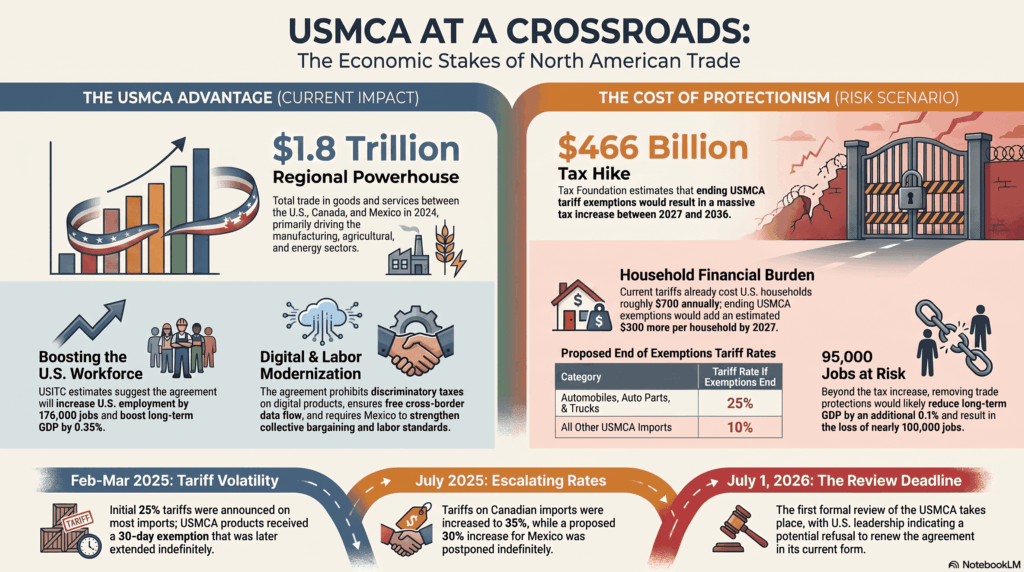
Together, Canada and Mexico accounted for more than $1.8 trillion in trade in goods and services in 2024. They primarily drive the manufacturing, agricultural, and energy sectors. The value chain depends on cross-border flows.
The USMCA modernized the North American Free Trade Agreement (NAFTA). While NAFTA had reduced tariffs to zero for most goods traded among the three countries, the USMCA focused on the remaining non-tariff barriers in digital services, e-commerce, and intellectual property.
The USMCA requires all parties to ensure the free flow of data across borders and prohibits discriminatory treatment. This includes tariffs on digital products or the forced localization of data centers.
GDP and Jobs
Other significant changes included scaling back the investor-state dispute settlement mechanism (which allowed investors to file claims before an international tribunal if they suffered unfair regulatory treatment), tightening rules of origin requirements for automobiles, and requiring Mexico to strengthen its labor standards by improving its collective bargaining agreements.
Overall, the USITC estimated that the agreement would boost long-term GDP by 0.35% and increase U.S. employment by 176,000 jobs.
Strategic Approach
For companies that trade or invest in North America, the lesson is clear: regional integration remains a competitive advantage. Moreover, regulatory certainty, logistical proximity, and shared supply chains enable companies to achieve economies of scale, reduce risks, and respond more quickly.
The T-MEC review, however, requires us to look beyond preferential access. Companies that anticipate changes in rules of origin, labor compliance, and digital trade will be able to protect their margins, avoid disruptions, and capitalize on new opportunities in manufacturing, energy, and services. Adapting early makes all the difference.