

The U.S. Department of Agriculture (USDA) highlighted six consumer trends in Mexico for 2026.
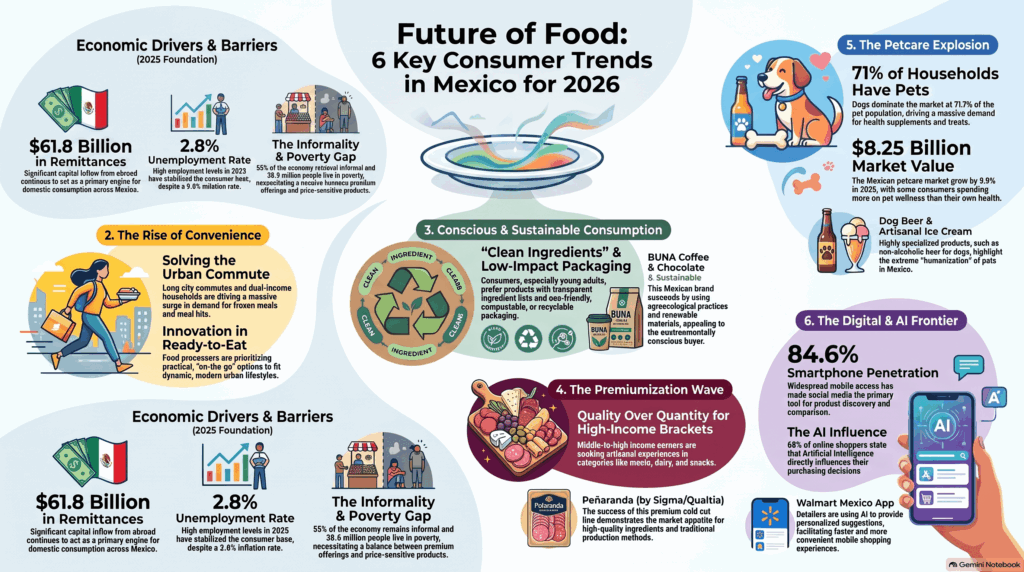
In Mexico, in 2025, the unemployment rate stood at 2.8%, inflation at 3.8%, and remittances at $61,800 million.
These figures drove consumer spending. However, there were also headwinds, such as an informal sector accounting for 55% of the economy, a poverty rate of 29.6% of the population (approximately 38.5 million people), and security issues.
Consumer Trends in Mexico in 2026
Mexican consumers are transforming the food industry by prioritizing well-being, convenience, and sustainability. This evolution is driving demand for premium products, e-commerce, and the pet market, opening strategic opportunities for exporters.
These are the trends described by the USDA, with examples added by Opportimes:
-
Focus on Well-being
Mexico is one of the fastest-growing markets for nutritional supplements and food products, with rising demand for items that are low in sodium or sugar, plant-based, nutritionally fortified, high in fiber, or containing probiotics.
Although the market is price-sensitive, Mexican consumers—especially young adults entering the workforce—are willing to pay more for products with additional health benefits.
The launch of Oikos Pro Shake in Mexico illustrates how young consumers are willing to pay more for convenient products with nutritional benefits. The drink offers protein, no added sugar, and ease of consumption, combining convenience, health, and perceived added value.
-
The Rise of Convenience Formats
Demand for frozen meals, meal kits, and ready-to-eat products is growing rapidly, driven by dual-income households and longer urban commutes. Food processors continue to innovate with more convenient options tailored to dynamic urban lifestyles.
The rise of dual-income households and longer urban commutes has made prepared and frozen meals the category with the highest level of food innovation, radically transforming supermarket offerings to save time in daily life.
3.- Preference for sustainability
Consumers, particularly young adults, are increasingly environmentally conscious and focused on consuming fresh products. Many prefer to buy foods with “clean ingredients” and packaged in materials with a low environmental impact.
The Mexican company BUNA reflects this trend by marketing coffee, chocolate, and honey made with ingredients sourced from Mexico. In addition, it works with producers to implement agroecological and agroforestry practices aimed at the conservation and regeneration of ecosystems, and uses various packaging solutions made from renewable, compostable, or recycled materials.
-
Premium Brand Value
A growing number of middle-to-high- and high-income consumers are willing to pay premium prices for quality products—especially well-known brands that use high-quality ingredients—and specialty foods. This trend applies particularly to meat products, dairy, snacks, beverages, and pet food.
Sigma is capitalizing on this trend in Mexico through Qualtia and its premium deli meat lines, such as Peñaranda. It offers artisanal deli meats made with high-quality ingredients for consumers seeking superior experiences.
5.- Expansion of the Pet Care Market
71% of households in Mexico have at least one pet. In this context, dogs dominate the pet food market with a 71.7% share. Consequently, demand is growing for pet care products, treats, and health supplements.
U.S. exporters lead these categories thanks to their solid reputation for quality and consistency. As a result, the Mexican pet food market reached an estimated value of 8,250 million dollars in 2025 (+5.9% compared to 2024).
Even in Mexico, there is a trend toward consuming non-alcoholic beer for dogs and specially formulated artisanal ice cream. Consequently, some Mexicans now spend more on animal welfare than on their own digestive or joint health.
-
Boost to E-commerce
Mexican consumers use social media and digital platforms to discover, compare, and purchase products. Therefore, this trend significantly expands market opportunities for U.S. products to achieve greater visibility, marketing, and nationwide distribution.
Currently, 84.6% of Mexicans own a smartphone. Additionally, 43.5% of consumers confirmed having made online purchases in 2025. Consequently, e-commerce is seeing rapid adoption across the country.
On the other hand, artificial intelligence is a major driver of this digital growth. In fact, 68% of shoppers say that AI directly influences their decisions, making online shopping an extremely effective channel.
Walmart Mexico is capitalizing on this environment by using artificial intelligence to suggest personalized items through its mobile app. This facilitates quick shopping from smartphones to cater to digital consumers who prefer the convenience of online shopping.