
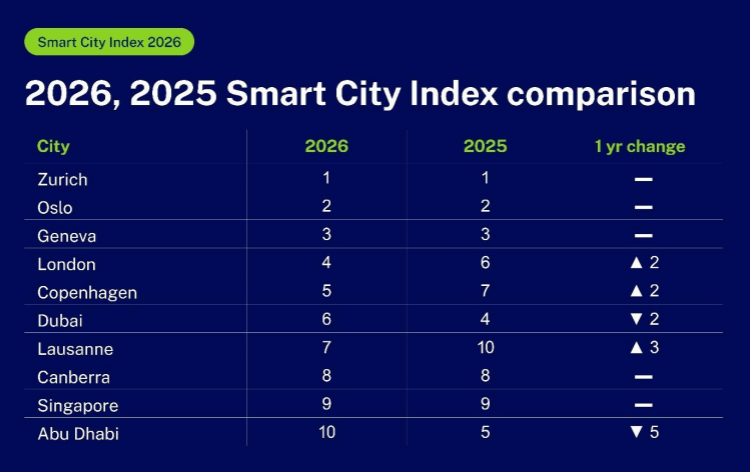
The IMD World Competitiveness Center has published the results of the 2026 Smart City Index. It evaluates 148 cities based on residents’ perceptions of infrastructure and technology in areas such as healthcare, mobility, and governance. Additionally, el informe destaca cuáles son las Smartest Cities in the World y cómo instituciones, confianza e infraestructuras se alinean para definir el éxito urbano actual.

The 10 Smartest Cities in the World
1.- Zurich (Switzerland)
Zurich maintains its undisputed leadership by once again topping the global ranking of smart cities. Its success lies in an exceptional balance between economic strength, applied technology, and sustainability. Thus, it guarantees a superior quality of life and unwavering public trust in its institutions.
2.- Oslo (Norway)
The Norwegian capital retains its second place globally, establishing itself as a leader in smart infrastructure and sustainable mobility. Furthermore, Oslo’s focus on government transparency and environmental well-being continues to receive very high ratings from its residents. Thanks to this, it maintains its status as a “super-champion.”
3.- Geneva (Switzerland)
Geneva remains firmly in third place on the international podium. It stands out for its effective implementation of technologies that improve public services and foster trust in digital government. Furthermore, it aligns perfectly with the region’s high expectations for human development and structural quality.
4.- London (United Kingdom)
The British metropolis has made significant progress by entering the exclusive group of the top five. London demonstrates that initiatives to make life easier for citizens through modern public transportation and digitalization can positively transform residents’ perceptions. In this way, they improve their urban opportunities.
5.- Copenhagen (Denmark)
Ranking fifth, the Danish capital reflects strong performance in mobility and safety. Copenhagen is celebrated for integrating green infrastructure with advanced technological solutions. In this way, it ensures that its citizens perceive continuous improvement in their daily environment, health, and urban maintenance services.
6.- Dubai (United Arab Emirates)
Dubai represents the success of the state-led digital investment model. By prioritizing the delivery of high-quality services, the city has generated remarkable civic trust among its residents. Furthermore, it positions itself as the leading benchmark for technology and data management in the Gulf region.
7.- Lausanne (Switzerland)
Lausanne continues its rise, climbing three spots from the previous year to rank seventh. Its focus on participatory governance and economic opportunities is key, coupled with Switzerland’s stability. This makes it a model of resilience and technological efficiency for other rapidly growing European cities.
8.- Canberra (Australia)
Canberra maintains a stable position within the global top 10 smart cities. The Australian capital stands out for its strategic alignment between robust infrastructure and institutional trust. This allows its residents to enjoy highly efficient public services and urban management focused on social inclusion.
9.- Singapore (Singapore)
As the only city with an AAA rating across all pillars of the index, Singapore is the global benchmark. Its comprehensive integration of technology into governance and daily life continues to set the international standard for efficiency, transparency, and the creation of new job opportunities.
10.- Abu Dhabi (United Arab Emirates)
Rounding out the group of leaders, Abu Dhabi demonstrates how strategic digital investment enhances quality of life. Like Dubai, this urban center stands out for its institutional responsiveness. It also excels in the high perceived quality of its technological infrastructure and public safety services.