
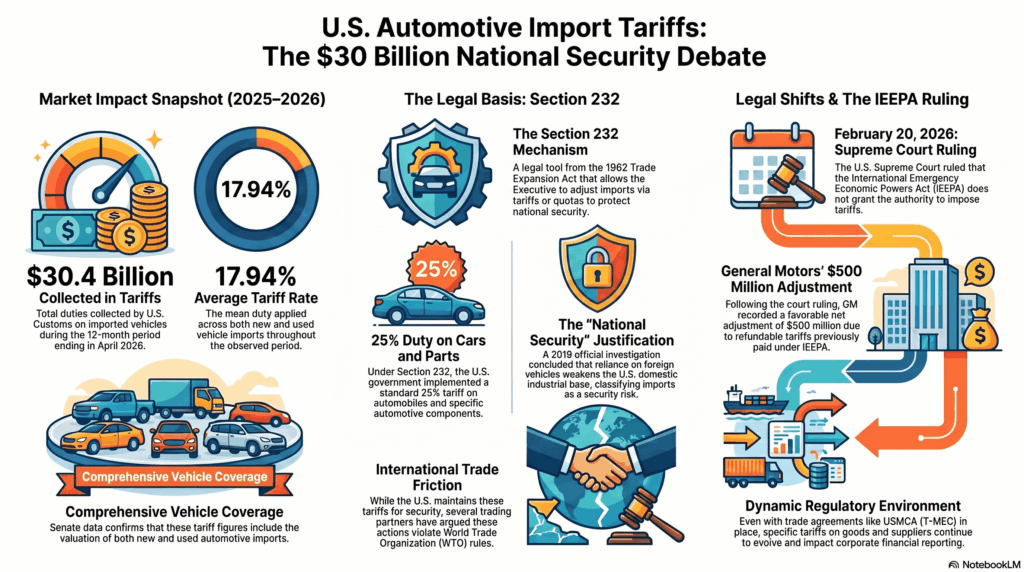
Tariffs levied on car imports into the United States totaled $30.4 billion in the 12 months ending in April 2026.
During this period, U.S. customs applied an average rate of 17.94% to these imports.
According to information from the U.S. Senate, the above data applies to both new and used cars.
Tariffs on Car Imports
Under Section 232 of the Trade Expansion Act of 1962, the U.S. government imposed a 25% tariff on imports of automobiles and certain auto parts. This regulatory measure transformed trade flows in the North American automotive industry due to its logistical and tariff implications.
What is Section 232 and how does it work?
Section 232 is a legal mechanism that grants the U.S. Executive Branch the authority to adjust imports through tariffs, quotas, or trade restrictions. To activate it, the Secretary of Commerce must first determine that the volume of an imported good poses a real threat to U.S. national security. To do so, the Secretary first conducts a formal investigation.
Origin and technical justification of the measure
The legal basis for this automotive tariff stems from an official investigation concluded in 2019. This analysis concluded that the growing reliance on foreign vehicles was weakening the domestic industrial base. Furthermore, automotive imports were formally declared a threat to U.S. national security.
Some countries, however, have argued that these actions violate World Trade Organization (WTO) rules.
IEEPA Tariffs
From General Motors’ perspective, the tariff environment remains highly dynamic. The specific tariffs applicable to goods imported by the company and its suppliers continue to evolve. This is true even for imports covered by the United States-Mexico-Canada Agreement (USMCA) and other trade agreements.
On February 20, 2026, the U.S. Supreme Court ruled that the International Emergency Economic Powers Act (IEEPA) did not authorize the imposition of tariffs.
Since it determined that previously paid amounts are refundable, General Motors recorded a net favorable adjustment of $500 million, primarily due to IEEPA tariffs previously charged in the quarter ended March 31, 2026.