
Tariffs and lower sales hit PACCAR’s profits in 2025, accumulating two year-on-year declines in this indicator.
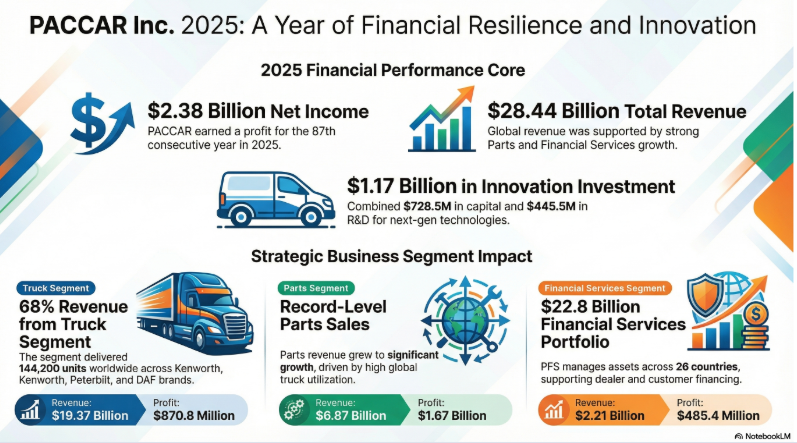
The company‘s net profit fell 42.9% annually in 2025, dropping to $2.3758 billion. The decline was due to an adverse operating environment, higher tariff costs, and an extraordinary legal charge in Europe, affecting margins in a highly cyclical global market.
PACCAR’s profits in 2025
PACCAR is a US manufacturer of heavy and medium-duty trucks, owner of the Kenworth, Peterbilt, and DAF brands. PACCAR designs, produces, and markets commercial vehicles. It also offers financial services and spare parts. It has industrial operations and a strategic presence in North America, Europe, and other international markets.
Total revenue amounted to $28.4448 billion, a year-on-year decrease of 15.5%. The contraction reflects lower global truck deliveries, competitive pricing pressure, and the impact of U.S. trade policy, particularly under Section 232, with effects on supply chains and industrial costs.
From 2022 to 2023, Paccar’s net income rose from $3.011 billion to $4.6 billion.
Impact of tariffs and litigation on profitability
The most significant extraordinary factor was a charge for litigation in Europe of $350 million before taxes, associated with civil claims linked to the European Commission. After taxes, the impact amounted to $264.5 million, eroding net profitability.
At the same time, increased tariff costs in the United States reduced the gross margin of the truck segment from 13.9% in 2024 to 7.5% in 2025. Price pressure in the United States, Canada, and Europe deepened the operating contraction.
Lower deliveries and weak demand
Global deliveries fell 22%, from 185,300 units in 2024 to 144,200 in 2025. Lower retail demand in major markets reflected the slowdown in freight transport, a leading indicator of the economic cycle and foreign trade dynamics.
In a context of tariff tensions and trade policy adjustments, the sector faces greater regulatory risks and volatility in input costs, affecting investment decisions and fleet renewal.
Financial performance and operational diversification
Investment income decreased from $394.7 million to $346.1 million, impacted by lower returns due to falling rates in the United States and Europe. However, the Financial Services segment showed resilience due to higher portfolio returns.
The Parts business also contributed stability, partially offsetting weakness in new unit sales. This diversification cushioned the impact on operating cash flow, although it did not prevent the contraction in net income.
One final note: the company’s research and development expenses fell at a year-on-year rate of 1.6% in 2025, to $445.5 million.
Strategic presence in Mexico and global competition
PACCAR maintains a significant position in Mexico through the manufacture of Kenworth and DAF trucks, with investments to expand production capacity. The company operates in a competitive environment against Daimler Truck, Iveco Group, TRATON SE, and AB Volvo.
Competition focuses on powertrain efficiency, electrification, financial services, and supply chain optimization. In the context of nearshoring in North America, production capacity in Mexico takes on strategic importance in meeting regional demand under existing trade agreements.
Implications for foreign trade and nearshoring
PACCAR’s performance reflects how tariffs and regulatory disputes can affect industrial profitability and foreign direct investment decisions. U.S. trade policy continues to influence manufacturing cost structures in North America.