

The United States imported $114 million worth of synthetic graphite from around the world in the first quarter of 2026, with Indonesia as the leading supplier.
These imports increased from $105 million in the first three months of 2025.
According to the North American Graphite Alliance (NAGA), graphite is vital to the defense industrial base. It is lightweight, heat- and corrosion-resistant, and an electrical and thermal conductor. This makes it a preferred component for military equipment and industrial applications.
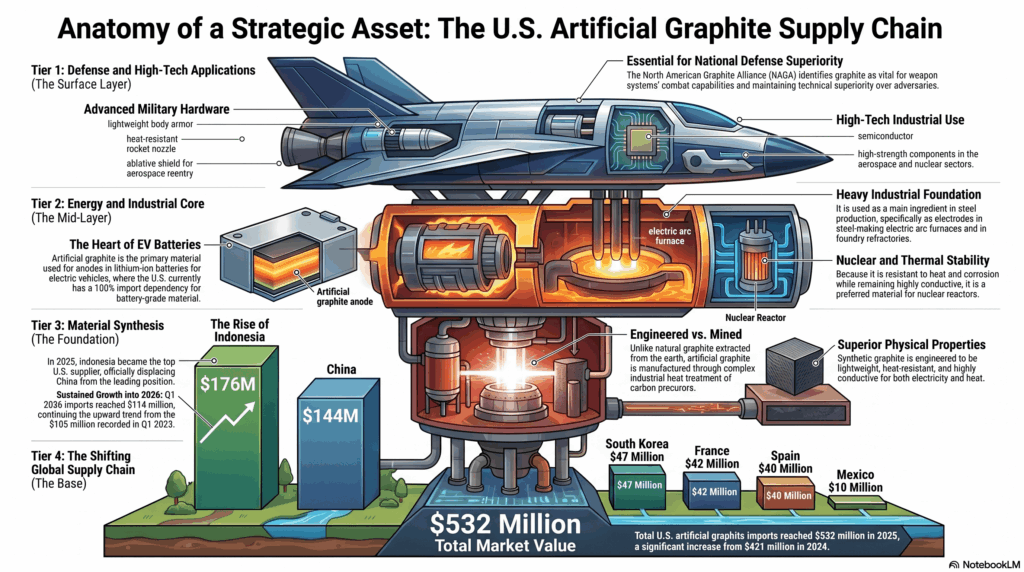
It is also used as a key ingredient in steel production and in refractory and foundry materials. Additionally, it is used in energy applications such as battery anodes, nuclear reactors, and semiconductors. Its military applications include bulletproof vests, rocket nozzles, and ablative shields.
Imports of Synthetic Graphite
Synthetic graphite is primarily used as an anode in lithium batteries for electric vehicles and as electrodes in steelmaking arc furnaces. It is also key in high-strength components in the aerospace, nuclear, and semiconductor industries. This is due to its extreme purity and conductivity.
Artificial graphite (also known as synthetic graphite) is a high-tech engineering material manufactured by humans through the thermal treatment of high-purity carbon precursors. Unlike natural graphite, which is extracted from the earth as a mineral, synthetic graphite does not come from mines but from complex industrial processes.
In 2025, the United States imported artificial graphite with a customs value of $532 million. Its foreign purchases of this material totaled $421 million in 2024, according to data from the U.S. Department of Commerce.
Indonesia ranked as the top foreign supplier of artificial graphite to the U.S. market in 2025, with $176 million. In doing so, it displaced China from the top spot, whose sales to that market totaled $144 million. South Korea ($47 million), France ($42 million), Spain ($40 million), and Mexico ($10 million) followed.
Military Sector
According to NAGA, within the defense industrial base, critical materials enable the unique combat capabilities of U.S. weapons systems. Furthermore, they provide the essential inputs to expand the industrial base in an emergency and maintain technical superiority over adversaries.
History shows that without these materials, industrialized nations have been forced to make performance compromises—such as resource shortages that have led to production shortfalls—which contributed to their defeat on the battlefield.
However, China controls more than 77% of global graphite production, and the United States is 100% dependent on imports of battery-grade graphite from China for lithium-ion batteries.
The following table shows U.S. imports of synthetic graphite from around the world, in millions of dollars:
- 2018: 361.
- 2019: 369.
- 2020: 168.
- 2021: 242.
- 2022: 491.
- 2023: 441.
- 2024: 421.
- 2025: 532.