

The Mexican government informed its U.S. counterpart that the optimization of private supply chains has boosted trade flows between the two nations. It also reported that there is a growing trend of bilateral joint production.
“This development has been driven by the optimization of private-sector supply chains rather than government-led capacity expansion policies,” said the Ministry of Economy.
Trade integration is a key factor for the global competitiveness of the North American region.
Supply Chain Optimization
Last week, Mexico asked the USTR to exclude it from investigations into excess capacity. It also warned that new tariffs would harm regional competitiveness.
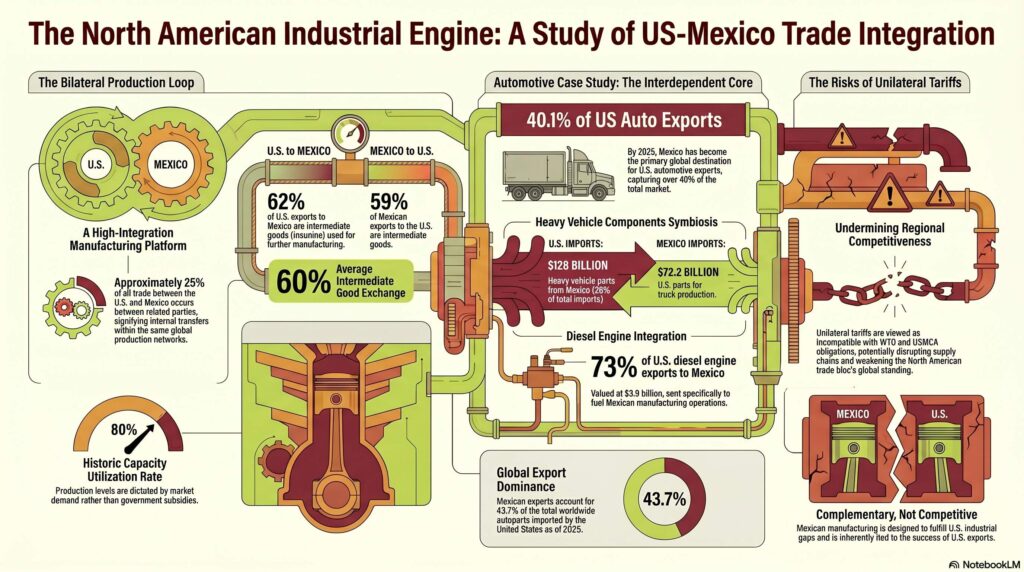
Among its arguments, the Ministry of Economy stated that Mexican manufacturing production complements U.S. industrial demand. Furthermore, it said that it is closely linked to U.S. exports.
Between 2010 and 2024, trade in manufacturing inputs and finished goods expanded significantly in both directions. This reflects the growing fragmentation and specialization of production in North America.
Automotive trade
By 2025, Mexico had become the leading global destination for U.S. automotive exports, accounting for up to 40.1 percent of the total.
As another example, Mexico has established itself as a key supplier of heavy-duty vehicle components for the U.S. market, which are used in final U.S. production.
In 2024, the United States imported nearly $128 billion in heavy-duty vehicle parts from Mexico. This represented approximately 28% of total U.S. imports.
In 2025, Mexican exports accounted for 43.7% of total U.S. global imports of auto parts.
Overall, the Ministry of Economy highlighted that these data illustrate a highly integrated two-way production system in which intermediate goods cross borders multiple times before final assembly.
The automotive sector between the United States and Mexico operates as a single, interdependent manufacturing platform, where competitiveness depends on the efficiency, reliability, and continuity of cross-border supply chains.
Similar patterns of integration exist in other sectors under investigation. In all these industries, Mexican manufacturing output complements U.S. industrial demand and is closely linked to U.S. exports.