

Negotiations between Mexico and the United States could include restrictions on inputs from non-market economies into North America as part of the review of the United States-Mexico-Canada Agreement (USMCA).
Marcelo Ebrard, Mexico’s Secretary of Economy, and Jamieson Greer, the U.S. Trade Representative, will lead bilateral negotiations this week on the USMCA revision, following a series of technical discussions that took place in the spring of 2026.
Inputs from non-market economies
Mexico produces final goods using inputs from Asia, but the United States is demanding a reduction in this triangulation. In the USMCA revision, part of the negotiations focuses on tightening rules of origin to replace Asian components with North American regional production.
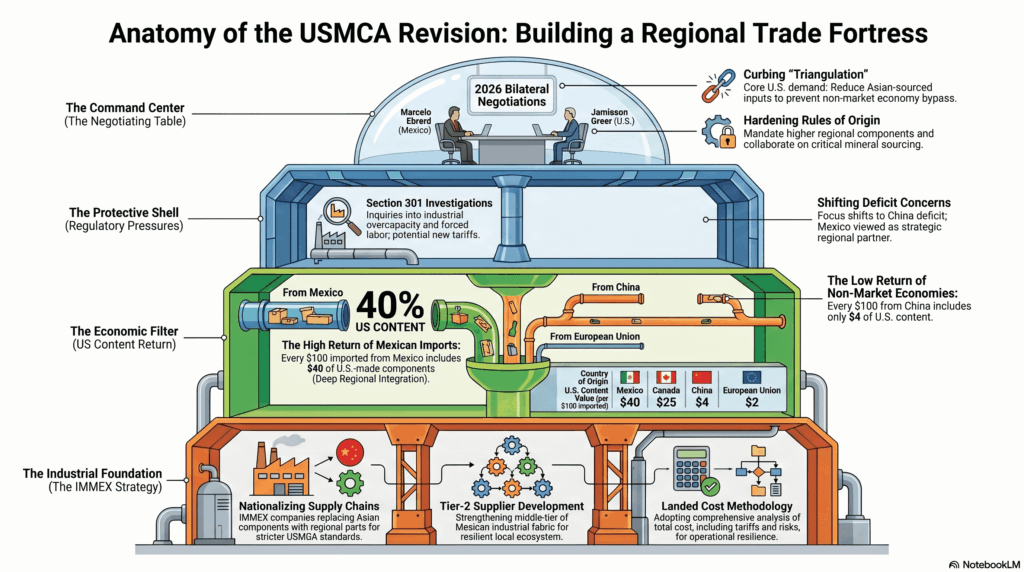
A recent U.S. Congressional analysis suggests that the bilateral negotiations could spark debates on North American supply chains, including restrictions on inputs from non-market economies.
In this same context, the negotiations could incorporate changes to rules of origin in certain industrial sectors. There is also interest in collaboration regarding critical minerals.
The landscape of foreign trade in North America is changing radically. Recently, Greer emphasized that his country’s main concern is the trade deficit in goods with China, rather than with Mexico.
The reason behind this is the deep regional integration and the value added shared by the USMCA partners.
U.S. Content
According to data from SAI Consultores from the late 2010s, U.S. imports from Mexico have a direct economic impact on its own industry, unlike what occurs with Asia or Europe.
Country of Origin: U.S. Inputs (per $100 imported)
- Mexico: $40.
- Canada: $25.
- China: $4.
- European Union: $2.
IMMEX Companies
In February 2026, the Trump Administration launched two investigations under Section 301 of the Trade Act of 1974. These investigations focus on industrial overcapacity and the prohibition of goods produced using forced labor, factors that could lead to new tariffs on imports from Mexico.
In light of these geopolitical tensions and tariffs on Asian inputs, companies in the IMMEX program are accelerating their regional integration through three pillars:
- Nationalized supply chains: Replacing Asian components with local suppliers.
- Development of Mexican Tier-2 suppliers: Strengthening Mexico’s industrial base.
Landed Cost Analysis: A logistics methodology that calculates the actual total cost of a product (from its origin to its final destination) to assess the impact of tariffs, mitigate risks, and improve operational resilience.