

Mexico set a record for foreign trade in April 2026, driven by growth across all major components of exports and imports, the National Institute of Statistics and Geography (INEGI) reported on Monday.
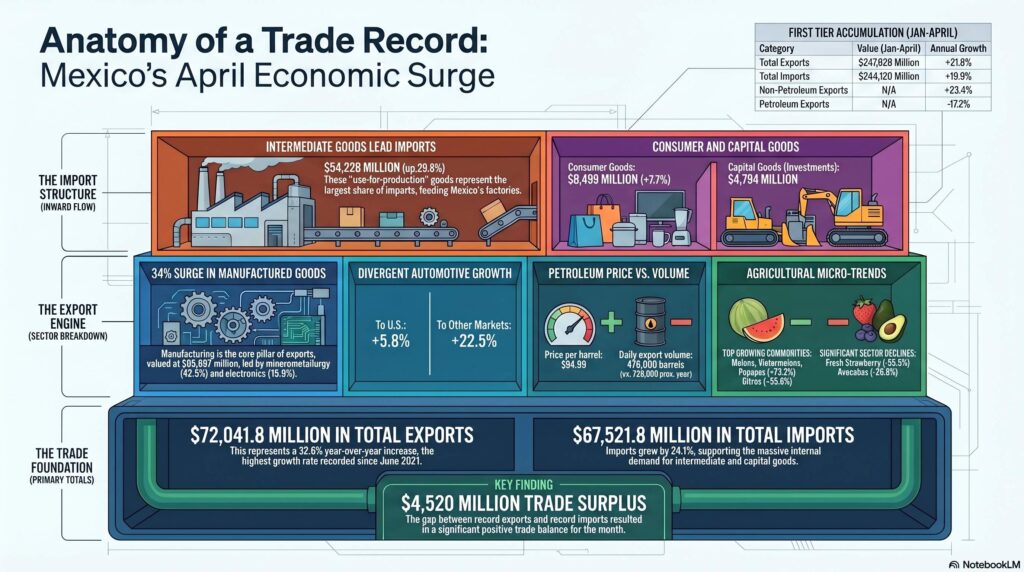
Mexican exports recorded their highest growth rate since mid-2021, surging 32.6% year-over-year to reach $72.0418 billion.
Meanwhile, imports of goods showed a solid increase of 24.1%, reaching $67.5218 billion.
With these results, the country achieved a trade surplus of $4.52 billion. This is a sign of strong competitiveness in global value chains.
Record in Foreign Trade
Overall, the flow of Mexican exports maintains key momentum, driven primarily by the manufacturing sector, with a broad base in the automotive industry and strong growth in computer production.
At the same time, this trade balance reflects close industrial integration with North America, sustaining the driving force behind domestic economic activity.
Manufacturing exports totaled $65.687 billion (+34.0%). The sectors with the strongest growth were mining and metallurgy (+42.5%) and electrical and electronic equipment (+15.9%).
Meanwhile, the automotive industry recorded an 8.2% increase, strongly driven by market diversification, as exports to destinations outside the United States grew by 22.5%.
With a value of $2.23 billion, the agricultural sector showed mixed performance. Notable increases were seen in melons, watermelons, and papayas (+73.2%) and citrus fruits (+55.8%). However, there were declines in strawberries (-56.5%) and avocados (-28.8%).
The non-oil extractive sector reported a 71.0% increase in exports, reaching $2.078 billion.
Oil Trade
Meanwhile, the oil sector reflected a scenario of lower volumes but higher prices. Although the Mexican export blend rose to $94.99 per barrel (an increase of $33.98 compared to April 2025), the volume of crude oil shipped abroad fell to 478,000 barrels per day.
For analysts and decision-makers, import trends serve as a direct barometer of domestic production.
For analysts and decision-makers, import trends serve as a direct barometer of domestic production.
Imports of intermediate goods (industrial inputs and components) totaled $54.228 billion, representing a 29.8% increase over the previous year, confirming the equipping and supply of the country’s manufacturing plants.
Likewise, imports of consumer goods reached $8.499 billion (+7.7%), tempered by a 5.3% decline in purchases of energy products such as gasoline and LP gas, while capital goods imports totaled $4.794 billion (+1.3%).