

Private investment in automotive fixed assets has quadrupled in North America since the ratification of the USMCA, compared to the corresponding period prior to that, according to General Motors.
Specifically, during fiscal year 2025, General Motors allocated $9.3 billion to capital expenditures, 14.1% less than the $10.83 billion spent in 2024. This is part of its capital optimization strategy as it transitions to electric vehicles and batteries.
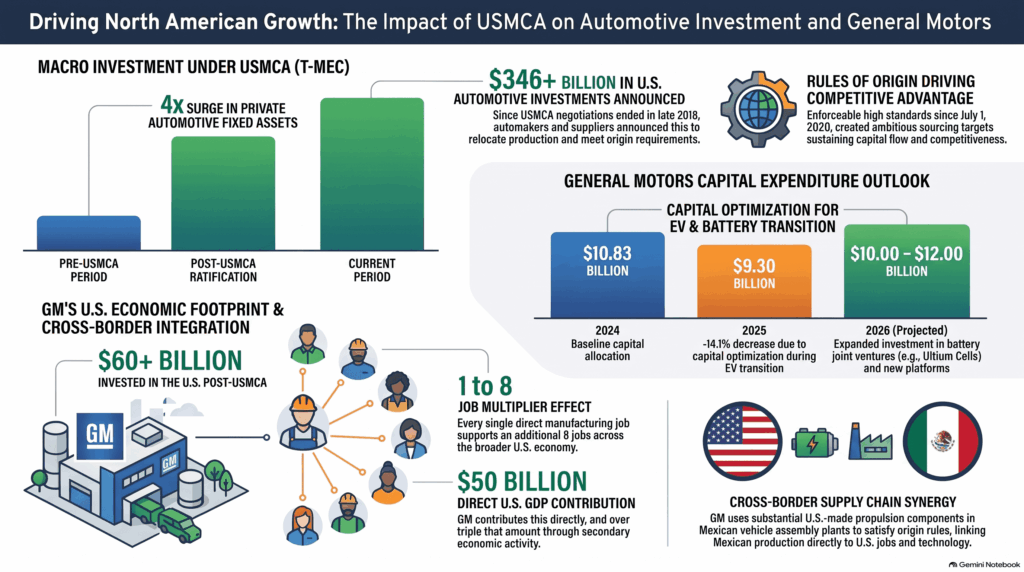
For 2026, General Motors projects capital expenditures of between $10,000 and 12,000 million. This amount includes investments in automotive operations, its battery cell joint ventures (such as Ultium Cells), and new vehicle platforms.
Private Investment in Automotive Fixed Assets
Since the USMCA negotiations concluded in late 2018, automakers and their suppliers have announced more than $346,000 million in investments within the United States. The funds will be used to relocate production and comply with the treaty’s automotive rules of origin, according to the Center for Automotive Research.
Overall, the high standards agreed upon by the parties—effective as of July 1, 2020—established ambitious yet achievable investment and sourcing requirements that have driven U.S. investment.
These investments create jobs in all three countries. For example, General Motors uses a significant number of U.S.-made powertrain components in vehicles manufactured in Mexico. This ensures compliance with rules of origin, thereby linking vehicle production in Mexico to U.S. jobs and technology.
Rules of Origin
Since the USMCA took effect, General Motors has made additional investments in North America. This includes more than $60,000 million in the United States.
General Motors contributes about $50,000 million directly to U.S. GDP and more than triple that amount through the economic activity of its employees and suppliers.
Every manufacturing job at General Motors supports eight other U.S. jobs.
Highlighting these latest figures, Omar A. Vargas, vice president and head of Global Public Policy at General Motors, emphasized last January that the USMCA is essential to supporting these investments. He stressed that the integration of North America’s industrial capabilities and preferential tariff access sustain this flow of capital. Thanks to these mechanisms, he concluded that U.S. automakers can maintain their relative competitiveness on a global scale.