
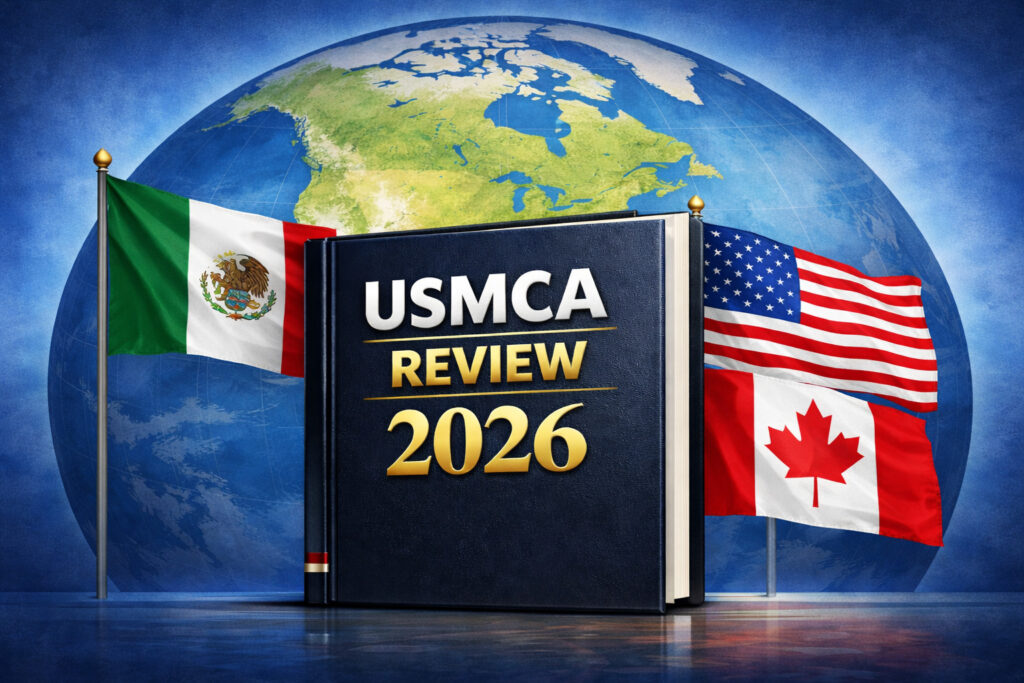
The United States Trade Representative (USTR) made the renewal of the United States-Mexico-Canada Agreement (USMCA) conditional on the resolution of several issues during the 2026 Joint Review.
Firstly, US trade policy will prioritize correcting imbalances in foreign trade, following the detection of a sustained increase in bilateral trade deficits, according to the USTR’s 2026 Trade Policy Agenda and 2025 Annual Report.
Trade deficit and regulatory tensions in foreign trade
The goods deficit with Mexico rose from $111 billion in 2020 to approximately $197 billion in 2025. At the same time, the negative balance with Canada grew from $14 billion to $46 billion over the same period.
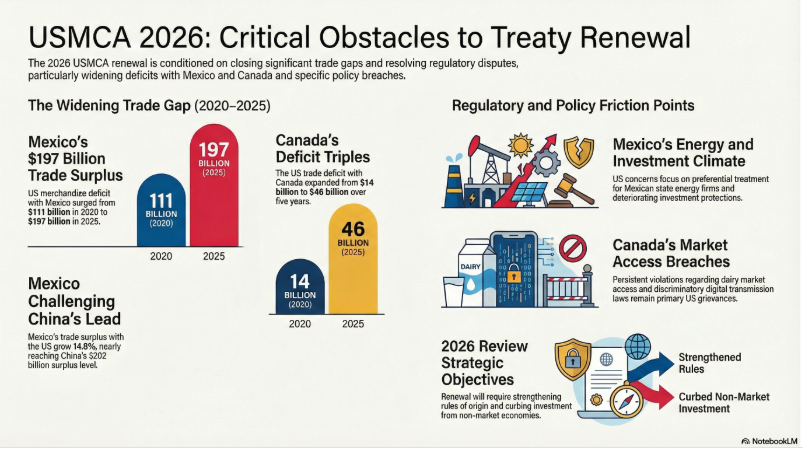
Mexico came close to surpassing China in its trade surplus with the United States in 2025. China’s surplus fell 31.6% year-on-year to $202.071 billion. In contrast, Mexico’s positive balance rose to $196.913 billion, an increase of 14.8%.
According to the USTR, the USMCA was an important step toward rebalancing economic relations, although structural problems remain. The United States maintains that deficits with Mexico and Canada have increased since the treaty came into force, requiring regulatory adjustments.
Investment climate
According to the USTR, the USMCA was an important step toward rebalancing the United States’ economic relations with Mexico and Canada, but many problems remain to be solved. The USTR specifically cited the following examples in this regard:
- Not only does the United States continue to run large trade deficits with Mexico and Canada, but these deficits have increased since the USMCA came into force.
- Mexico has adopted a series of preferential measures to benefit domestic leaders in its energy and mining sectors, particularly with regard to oil, gas, and electricity, to the detriment of U.S. investors.
- Mexico’s inadequate labor laws and poor enforcement of those laws continue to harm U.S. workers.
- Canada continues to maintain policies that violate its dairy market access commitments under the USMCA.
- Canada maintains discriminatory and restrictive digital measures, including its Online Transmission Act.
- Mexico has deteriorated its overall investment climate.
Challenges in foreign direct investment and industrial overcapacity
Canada faces questions for failing to comply with commitments on market access for dairy products and maintaining restrictive digital measures. The review of the USMCA, scheduled for July 2026, will seek to strengthen rules of origin in strategic sectors and establish effective mechanisms against transshipment of goods and production relocation. The goal is to prevent the benefits of the agreement from flowing to entities outside the region.
And the 2026 agenda is expected to address the increase in foreign direct investment from non-market economies in the area. The United States seeks to mitigate the effects of industrial overcapacity on the supply chains of the three trading partners.