
The Ministry of Economy presented the main concerns of Mexican companies regarding the review of the United States-Mexico-Canada Agreement (USMCA).
Among these concerns were the persistence of unilateral measures imposed by the United States under Section 232 of the Trade Expansion Act of 1962, which allows tariffs to be applied on grounds of “national security.”
Unfair competition resulting from trade triangulation and the lack of regulatory harmonization on technical, health, and environmental issues were also prioritized. In addition, dependence on critical inputs not produced in North America was included.
Concerns about the USMCA review
Mexico’s productive sectors also highlighted the importance of advancing energy and logistics infrastructure, as well as promoting the transition to a clean and stable energy matrix.
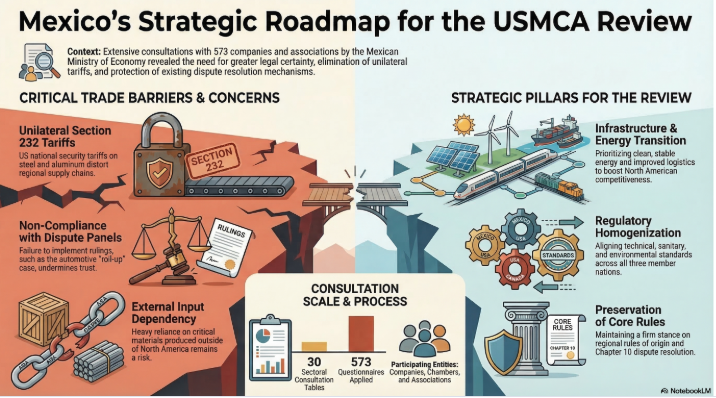
According to the participants in the sectoral roundtables, Mexico must maintain a firm position in defense of regional free trade, the current rules of origin, and Chapter 10 on dispute settlement.
At the same time, the review of the USMCA should focus on optimizing its implementation. Although the common position is not to reopen substantive chapters, some sectors such as mining, energy, aerospace, tourism, and the social economy proposed the creation of specific chapters for these areas. The industrial sectors agreed that legal certainty, energy availability, and trilateral technological cooperation are fundamental pillars for consolidating North America’s competitiveness.
For this consultation, the Ministry of Economy organized 30 sectoral consultation tables last year and administered 573 questionnaires to companies, chambers, and industry associations in order to identify common perceptions, regulatory challenges, areas of opportunity, and technical proposals related to the functioning of the USMCA.
Section 232
The need to ensure effective compliance with dispute panels was identified as a cross-cutting concern during the consultations. Various sectors stressed the importance of avoiding internal non-tariff barriers and strengthening the enforcement of rulings issued within the mechanism.
In addition, participants pointed to previous experiences such as the case of the automotive sector known as “roll-up.” In that episode, the United States did not comply with the relevant panel’s ruling. For this reason, the sectors highlighted the importance of ensuring the effective implementation of decisions.
At the same time, various sectoral roundtables—particularly in steel, aluminum, metalworking, and electronics—requested the elimination of the measures applied by the United States under Section 232. These provisions are justified on the grounds of national security within U.S. trade policy.
Although the request was expressed in general terms, the industry believes that these unilateral tariffs raise costs, distort intraregional trade, and create uncertainty in North American production chains. Consequently, several sectors reiterated the need to review their impact.
However, from a technical perspective, Section 232 corresponds to a power provided for in U.S. law, specifically in the Trade Expansion Act of 1962. Therefore, this provision cannot be eliminated through the review of the USMCA.