

Japanese investment in the United States remains in first place, with a strong surge expected in 2025. Bilateral trade in goods also increased.
From January to May 2026, trade in goods between the two economies grew at a year-over-year rate of 2.7%. As a result, these trade flows totaled $99,003 million.
Japanese Investment in the United States
The Japanese government wishes to emphasize its firm commitment to strengthening the economic partnership between Japan and the United States.
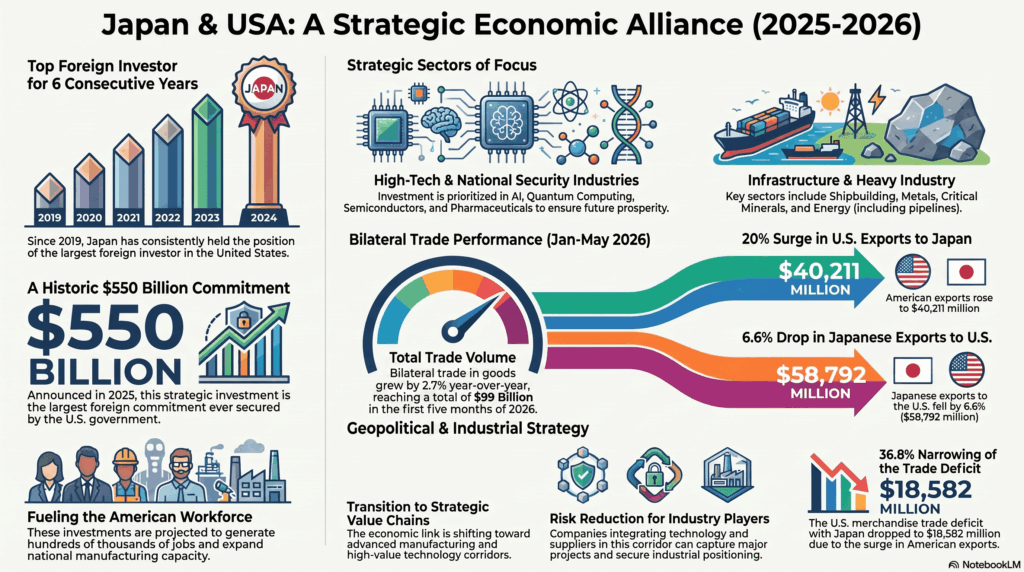
According to Japan’s Ministry of Economy, Trade and Industry, Japan has been the largest foreign investor in the United States for six consecutive years since 2019 and is also the United States’ sixth-largest trading partner (considering U.S. imports and exports).
Furthermore, in 2025, Japan committed to making a strategic investment of $550,000 million in the United States across various sectors to promote economic and national security interests, including, among others, semiconductors, pharmaceuticals, metals, critical minerals, shipbuilding, energy (including oil pipelines), and artificial intelligence/quantum computing.
We also know that the White House described this agreement as “the largest foreign investment commitment ever secured” and that it “will create hundreds of thousands of jobs in the United States, expand domestic manufacturing, and ensure American prosperity for generations to come.”
Bilateral Trade
In the first five months of 2026, Japan’s exports of goods to the U.S. market fell 6.6% year-over-year, to $58,792 million.
Conversely, U.S. exports of goods to the Japanese market grew 20%, to $40,211 million.
As a result, the United States had a $18,582 million deficit in its merchandise trade balance with Japan. This represented a 36.8% decline compared to the same period in 2025, according to data from the Department of Commerce.
Geopolitical Shift
The economic relationship between the United States and Japan combines large-scale investment with more balanced trade in 2026. The growth in U.S. exports and the smaller bilateral deficit point to a productive relationship increasingly focused on strategic value chains and advanced manufacturing.
For companies, the message is clear: Japan is investing in production capacity in the United States, especially in high-value sectors. Those who integrate suppliers, technology, and a commercial presence in that corridor will be able to secure projects, reduce risks, and ensure their industrial positioning.