

Investment control mechanisms have increased worldwide, according to a report by the United Nations Conference on Trade and Development (UNCTAD).
The expansion of investment control mechanisms, foreign investment controls, and other security-related measures reflects a renewed concern for safeguarding critical assets and limiting technology outflow.
Investment Control Mechanisms
For companies operating internationally, especially in strategic sectors, these changes translate into greater pressures on the geography and structure of their operations.
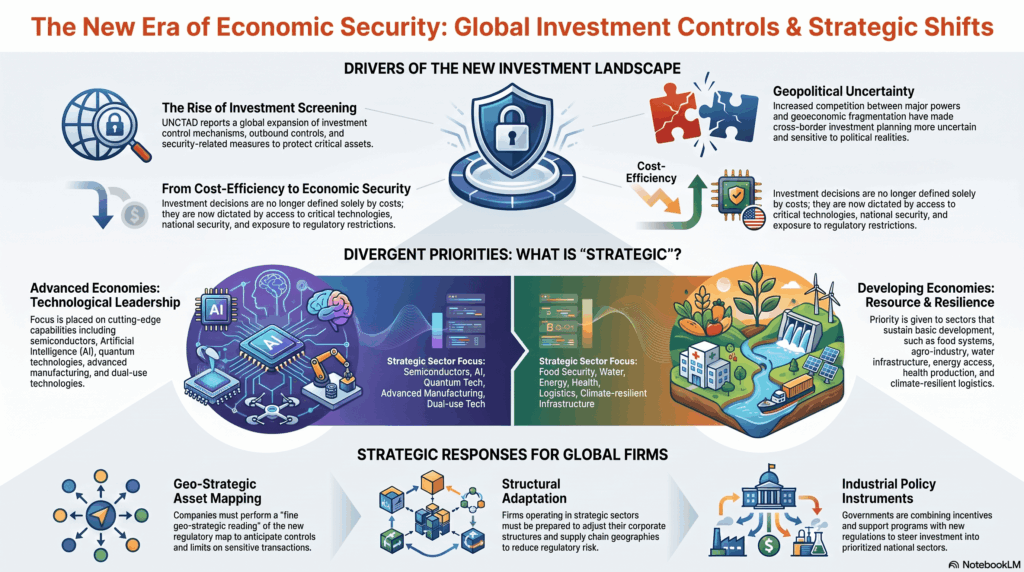
Industrial policies and economic security measures are transforming investment decisions. Incentives, subsidies, controls, national security exceptions in investment agreements, outbound controls, and other security-related measures are steering investment toward priority sectors, while limiting transactions deemed strategically sensitive.
National Security
The meaning of “strategic” is not uniform across all countries. For major advanced economies, strategic sectors are typically defined from the perspective of technological leadership, national security, and control over cutting-edge capabilities. These include areas such as semiconductors, AI, quantum technologies, advanced manufacturing, and dual-use technologies.
In contrast, for many developing economies, the sectors of greatest strategic importance may be those that underpin resource security, resilience, and basic development needs. For example, this includes food systems, agribusiness, water infrastructure, access to energy, health-related production, logistics, and climate-resilient infrastructure.
Recent trade disruptions, geopolitical tensions, and geoeconomic fragmentation have reinforced the strategic importance of these sectors. At the same time, climate change increases their vulnerability. Furthermore, it raises the cost of underinvestment.
Critical Technologies
The global landscape of international production is undergoing a profound transformation. The world economy is influenced by growing competition among major powers, escalating geopolitical tensions, and uncertainty regarding trade policy.
As a result, the environment in which companies plan, execute, and manage their cross-border investments has become more uncertain, more fragmented, and more sensitive to geopolitical realities.
Policymakers are placing increasing emphasis on economic security. Control over vital infrastructure, access to critical technologies, and positioning in sectors expected to drive future economic growth have become central considerations. These now guide the design of investment policies.
Governments are deploying a wide range of industrial policy instruments to steer investment toward sectors deemed strategic. In particular, they combine incentives and support programs with new forms of regulation and restriction.
Strategic Regionalization
For companies engaged in international trade or FDI, the new regulatory landscape requires a more nuanced geostrategic analysis. Investment is no longer defined solely by costs, but by access to critical technologies, national security, and exposure to restrictions.
Consequently, companies will need to adjust their geographic focus, supply chains, and corporate structures with greater selectivity. Meanwhile, those operating in strategic sectors will need to anticipate controls, incentives, and limits on sensitive transactions. This will help preserve competitiveness, reduce regulatory risk, and sustain international expansion.