
International companies account for 22% of US exports, according to the Global Business Alliance (GBA).
In the United States, international companies directly employ 8.4 million US workers and offer compensation that is 7% higher than the US private sector average, accounting for 22% of US exports.
International companies
In addition, nearly one in four manufacturing workers in the United States receives their salary from an international company. Thus, foreign investment supports thousands of key industrial jobs.
They not only contribute capital, but also transfer high-level technical knowledge. In this way, they drive innovation and strengthen the competitiveness of the U.S. workforce.
Each year, these companies spend more than $80 billion on research and development in the United States. As a result, they account for about 12% of all R&D conducted by U.S. companies.
These figures were presented by Danny Meza, director of trade policy at the Global Business Alliance, as part of the organization’s position during the USTR’s review of the USMCA.
“The Global Business Alliance recognizes that the USMCA creates an integrated and resilient North American supply chain that benefits the U.S. economy and national security,” Meza said.
This Alliance brings together more than 200 of the world’s most recognized companies. Although their global headquarters are located outside the United States, each is a significant employer in the country. On average, they generate 12,000 U.S. jobs per company.
Manufacturing in the United States
Like most international companies in the United States, member companies are headquartered in countries considered old friends and allies of the country. Thus, investment comes from reliable economies.
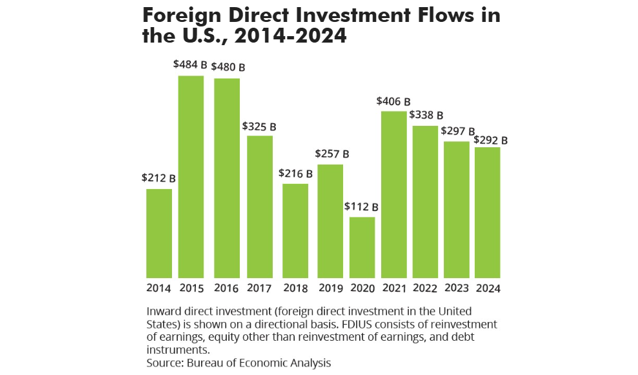
In this context, manufacturing is consolidating its position as the main destination for foreign investment in the United States. In addition, the sector recorded a 29% increase in the five years following the entry into force of the USMCA. International companies injected an additional half a trillion dollars into their operations during that period.
In turn, President Donald Trump issued the “America First” Investment Policy one month after beginning his second term. According to Meza, this strategy underscores the importance of welcoming foreign investment as a pillar of economic leadership. This vision is also echoed in Congress.
In fact, earlier this year, the House of Representatives unanimously passed the Global Investment in American Jobs Act. The text states that the United States’ ability to attract foreign direct investment from responsible companies based in reliable countries is directly linked to long-term economic prosperity, global competitiveness, and national security.