
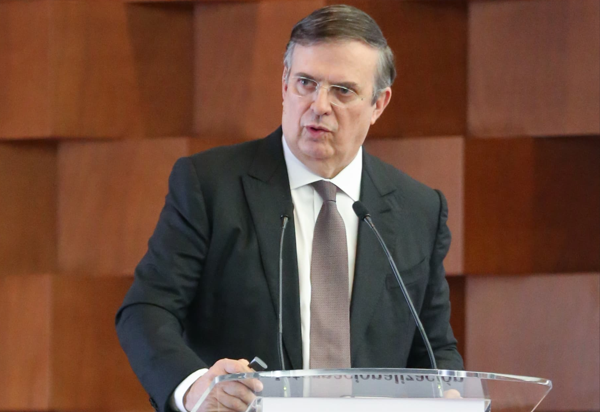
Industrial subsidies in China have affected several productive sectors in Mexico, Economy Secretary Marcelo Ebrard said Wednesday.
In part, Ebrard used this to justify a recent tariff measure by Mayor Claudia Sheinbaum. She published in the Official Gazette of the Federation (DOF) an increase in tariffs in Mexico on countries without trade agreements. This includes China. These tariffs took effect on January 1.
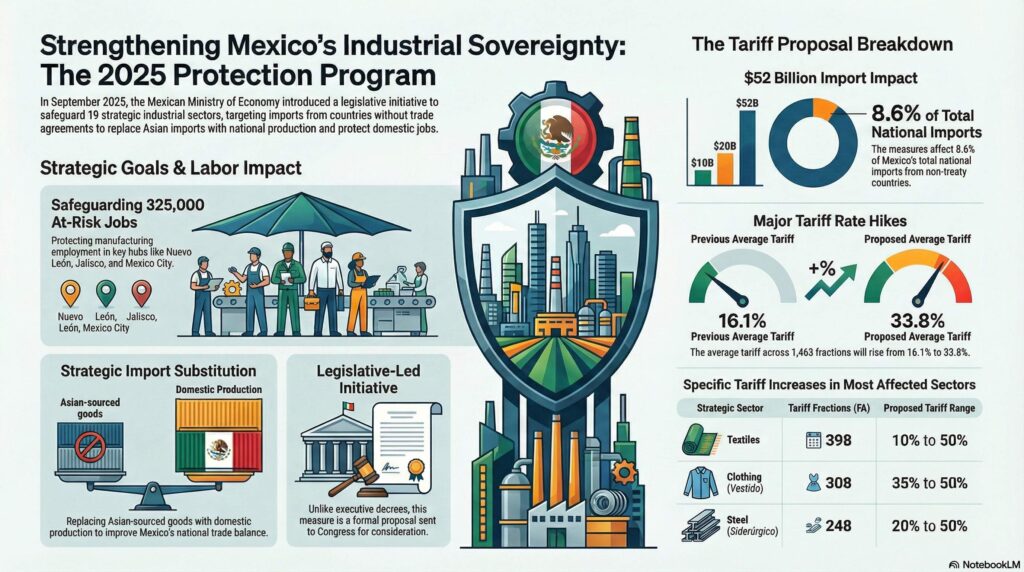
This publication was the final step to implement the Mexican Congress’s approval to raise tariffs on 1,463 tariff lines by up to 50%, the same amount proposed by Sheinbaum, although lawmakers removed 123 and added 123.
Industrial Subsidies in China
The product categories specifically affected include automobiles and parts, textiles, clothing, plastics, steel, household appliances, aluminum, toys, furniture, footwear, leather goods, paper and cardboard, motorcycles, and glass.
“So, we imposed tariffs because we believe they are seeking to expand the market with the help of their government. The same goes for vehicles. These are below-cost prices,” said Ebrard at the 82nd CAINTRA Annual Assembly.
Mexican tariffs impact imports of products originating from countries without trade agreements, such as China, South Korea, India, Indonesia, and Brazil.
“Mexico imposed a series of tariffs because we believe the conditions are unfavorable for our industry. Specifically, in textiles, footwear, and steel. Because Chinese steel is costing Mexico $150 per ton, in any case.
“And after conducting every possible test with the industry based here in Monterrey, we concluded that (the Chinese) are not paying the same taxes or are receiving a very large subsidy. In other words, costs can vary significantly,” added Ebrard.
Tariffs and Trade Agreements
As a result, the Mexican Congress imposed tariffs ranging from 5% to 50%. The measure affects $52 billion in imports, according to calculations by the Ministry of Economy. That is, 8.6% of total foreign purchases.
With these changes, Mexican customs will increase tariffs from 20% to 50% on car imports from countries with which Mexico has no trade agreements.
The Mexican Congress made the main tariff adjustment in the auto parts sector compared to the tariff hike initiative presented by President Sheinbaum.
The original proposal called for an increase in 141 auto parts classifications; however, Congress eliminated 71 of these and added 4, so that in net terms, the number of products was cut nearly in half, to 74.