
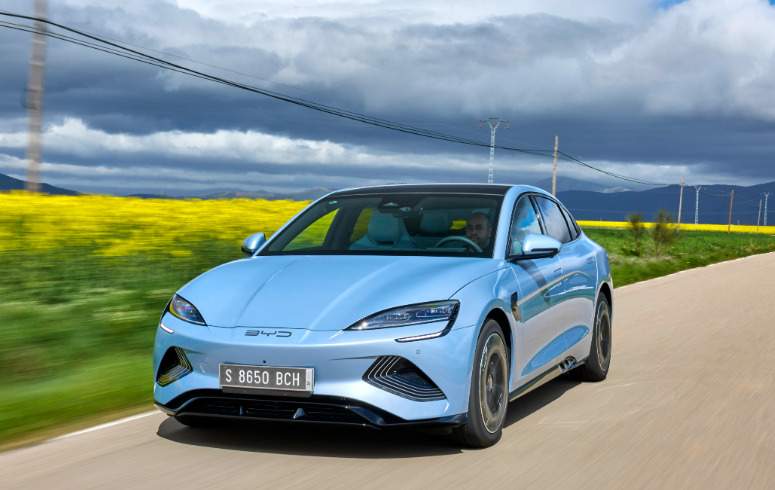
Imports of Chinese cars to Mexico grew at a year-over-year rate of 44.9% in 2025, reaching a record 6,346 units.
In Mexico, Chinese brands such as MG Motor, JAC, and BYD lead the market. In addition, they are followed by new firms like Geely and Changan. This is driven by competitive prices and better equipment. Furthermore, there is a growing selection of electric vehicles.
Imports of Chinese cars to Mexico
A decade ago, in 2015, Mexican purchases of Chinese cars totaled just $26 million. This is according to data from China’s General Administration of Customs.
U.S. consulting firms such as McKinsey & Company and the Boston Consulting Group highlight that China holds advantages in automotive production due to economies of scale, vertical integration, battery control, competitive labor costs, subsidies, and rapid innovation in electric vehicles.
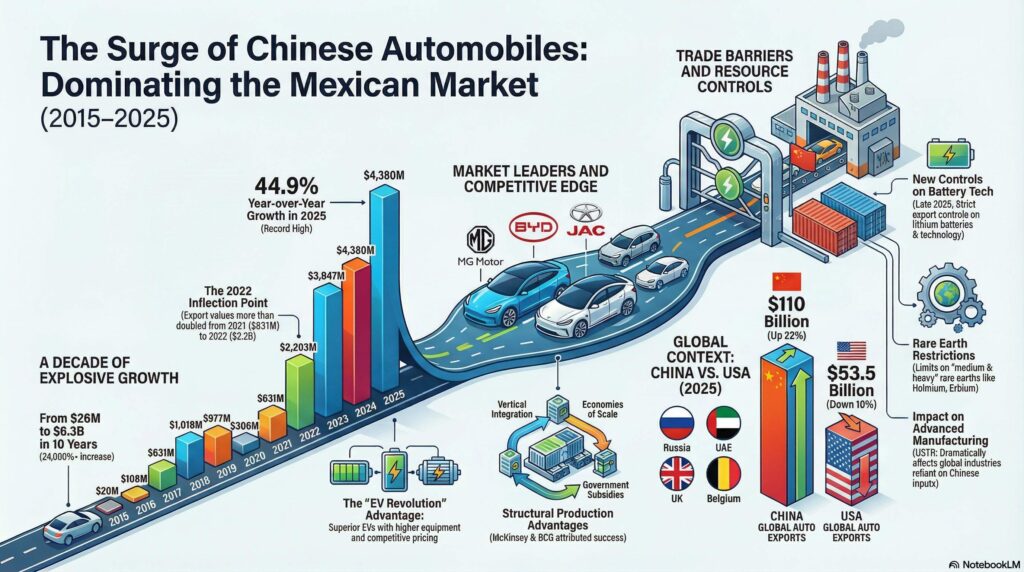
China exported $110 billion worth of cars worldwide in 2025. This customs value rose at a year-over-year rate of 22 percent. Among its main destinations are Russia, the United Arab Emirates, the United Kingdom, Belgium, and Mexico.
In contrast, U.S. automobile exports globally totaled $53.495 billion. This represents a 10% decline on an annual basis. In fact, the largest buyers of these vehicles were Canada, Germany, Mexico, the United Arab Emirates, and China.
Export Controls
In October 2025, China added additional medium- and heavy-duty rare earth elements to its export control regime—holmium, erbium, thulium, europium, and ytterbium. It also expanded its export controls to cover a range of technologies and equipment used in the production and processing of rare earth elements.
At the same time, China imposed export controls on lithium batteries, components, and technologies for use in vehicles and energy storage.
According to the U.S. Trade Representative (USTR), China’s rare earth export controls, in particular, have had a dramatic impact on a variety of global industries. These include the automotive, aerospace, medical device, wireless technology equipment, and other advanced manufacturing industries.
In 2014, the United States won a second dispute before the WTO, centered on export restrictions imposed by China on rare earths, tungsten, and molybdenum—key inputs for a multitude of products manufactured in the United States, including batteries for hybrid cars, wind turbines, energy-efficient lighting, steel, advanced electronics, automobiles, petroleum, and chemicals. China eliminated these export restrictions in 2015.