

Global mining exploration fell for three consecutive years, from 2023 to 2025, to $12.4 billion, according to the Mexican Mining Chamber (Camimex).
At its most recent peak, this indicator rose from $11.2 billion in 2021 to $13.0 billion in 2022.
The exploration phase is crucial for the mining industry, as it is the first step in identifying economically viable mineral resources.
Global Mining Exploration
Mining exploration and development involve inherent risks that cannot always be mitigated, even with the greatest expertise, knowledge, and technical rigor.
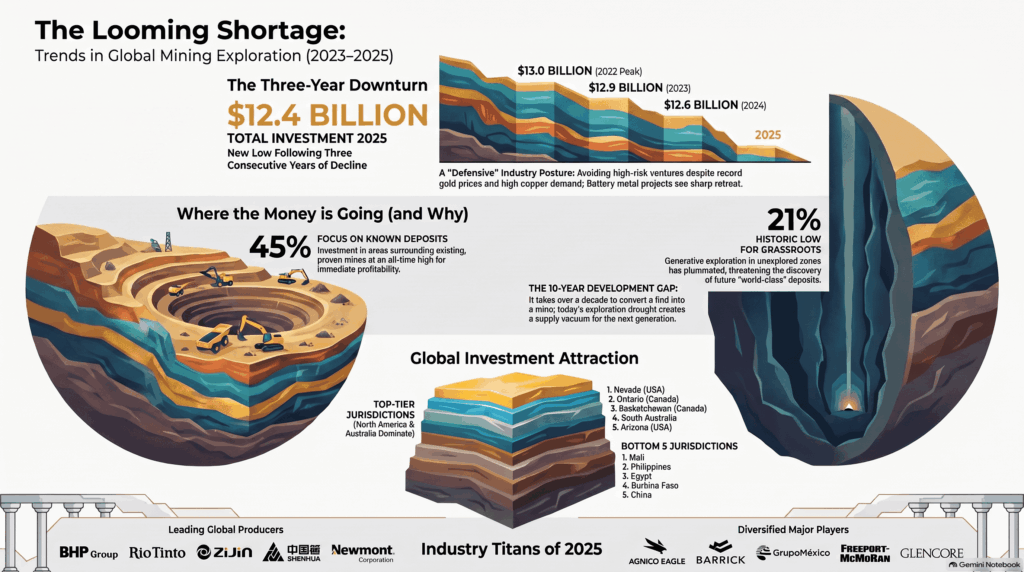
Following the recent peak, global mining exploration declined from $12.9 billion to $12.6 billion.
According to Camimex, the global mining industry adopted a defensive stance in 2025. On the one hand, record-high gold prices and strong demand for copper are keeping drilling activities going. However, investment in basic exploration has plummeted. Furthermore, investment in battery metals has seen a sharp decline. This lack of capital foreshadows an imminent global supply shortage.
Furthermore, turning a discovery into an operational mine takes more than a decade. Consequently, reduced activity in the early stages jeopardizes future supply chains.
Competition for Mining Capital
In terms of attracting mining investment, the Fraser Institute’s Investment Attractiveness Index highlighted the top global jurisdictions. Nevada, Ontario, Saskatchewan, South Australia, and Arizona took the top five spots. In other words, the list is led by two U.S. states, two Canadian provinces, and one Australian state.
In contrast, among the 68 jurisdictions evaluated, the bottom spots went to Mali, the Philippines, Egypt, Burkina Faso, and China.
Mining exploration represents the initial phase in the development of mineral resources. Generally, this activity is repeated multiple times in the same area over time. Therefore, no territory is considered fully explored.
Furthermore, constant technological advances and changing market conditions drive the ongoing reevaluation of previously studied areas to uncover their true potential.
Trends in Mining Exploration Investment
- Focus on Known Deposits: Exploration in the vicinity of proven deposits reached an all-time high, accounting for 45% of total investment.
- Plunge in Greenfield Exploration: In contrast, the search for entirely new deposits in unexplored areas fell to a historic low of 21%.
- Immediate Impact vs. Future Risk: Although expanding known resources offers immediate returns and lower risk, it reduces the likelihood of making the world-class discoveries that are essential for long-term global economic growth.
On a global scale, the largest mining companies in 2025 were: BHP Group Limited, Rio Tinto Group, Zijin Mining Group Company Limited, China Shenhua Energy Company Limited, Newmont Corporation, Agnico Eagle Mines Limited, Barrick Mining Corporation, Grupo México, S.A.B. de C.V., Freeport-McMoRan Inc., and Glencore plc.