

The annual reviews under the USMCA will begin as a result of the sunset clause. This creates a certain degree of uncertainty. Moreover, this uncertainty could undermine the region’s ability to attract investment compared to China and other Asian nations.
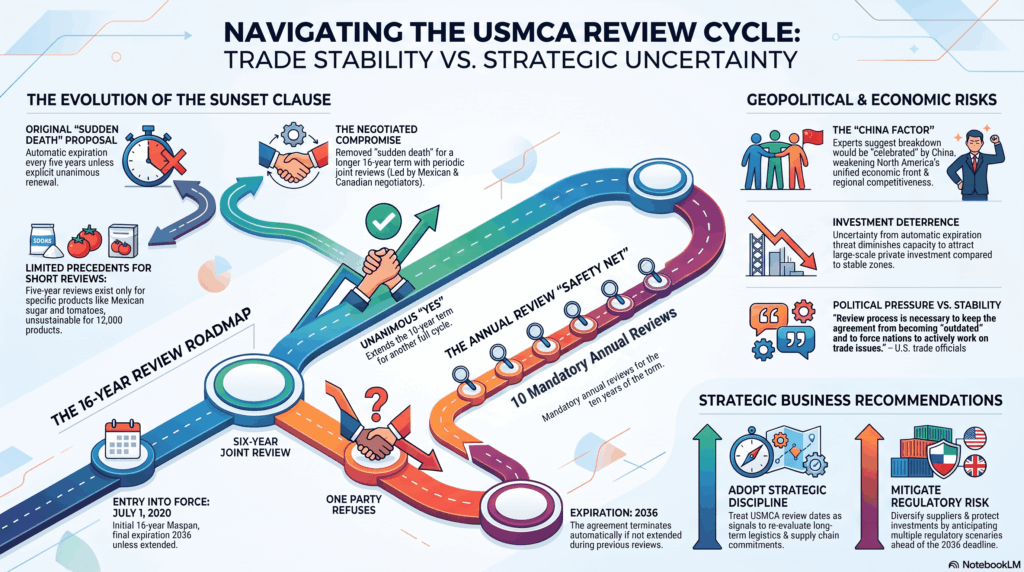
Under the sunset clause, proposed by President Donald Trump’s first administration, the USMCA would automatically expire every five years. This would happen unless the three countries agreed beforehand to renew the trade agreement.
However, this clause was ultimately not approved and was replaced by others championed at the time by Jesús Seade, the NAFTA chief negotiator for then-President-elect Andrés Manuel López Obrador.
Sunset Clause
During the fourth round, the U.S. government proposed including the sunset clause. Then, in the sixth round of negotiations, Canada officially announced that it approved Mexico’s proposal to establish the sunset clause, but without a “sudden death” provision.
Later, Robert Lighthizer, then U.S. Trade Representative, made no mention of Mexico’s counterproposal. This was interpreted as a sign of acceptance. Or, at the very least, as an indication that the United States was considering the proposals on the table.
Five-year reviews apply to a very small group of products. This is the case, for example, with Mexican sugar and tomatoes exported to the U.S. market. But extending the sunset clause to more than 12,000 product classifications was described as unsustainable by Francisco de Rosenzweig, a partner at the law firm White & Case.
Business Uncertainty
The inclusion of a joint review clause in the USMCA was the subject of controversy. During hearings held as part of the USMCA negotiations, several members of Congress expressed doubts about incorporating a mandatory review clause into the agreement. They argued that such a provision would create uncertainty. Furthermore, it could discourage private investment, and harm U.S. companies.
Some members questioned whether the sunset clause might circumvent Congress’s authority over trade agreements. Lighthizer argued that the USMCA’s joint review process allows Congress to exercise greater oversight than “perpetual” FTAs, which lack a mechanism for periodic review.
During negotiations on the terms of the USMCA, officials from the first Trump administration proposed a five-year “sunset clause.” They stated that the president would decide whether or not to continue the agreement five years after its entry into force.
An official from the Office of the United States Trade Representative (USTR) at the time argued that this clause would prevent the agreements from becoming “outdated.” He also stated that “considerable political pressure is needed to get nations to come together and work on these agreements.”
Canadian and Mexican officials opposed the U.S.’s initial proposal for a “sunset clause.” They argued that it would create uncertainty for investment and other economic activities.
Annual Reviews under the USMCA
The USMCA entered into force on July 1, 2020, and has an initial term of 16 years, through 2036. It is reviewed every six years. If there is no consensus, the treaty remains in effect but will automatically expire in 2036 if not renewed. If all parties agree to continue it, it will remain in effect for another 16 years.
And if any party does not confirm its desire to extend the agreement for another 16-year period, the parties will conduct a joint review each year during the remaining decade.
China “would welcome the collapse” of the USMCA, said former Chairman of the House Ways and Means Committee Kevin Brady. He advocates for a long-term renewal of the pact to strengthen North America’s position against China.
For businesses, the USMCA review should be seen as a signal to make decisions with greater strategic discipline. It is advisable to anticipate scenarios, protect investments, diversify suppliers, and adjust business plans more frequently. This helps to reduce risks and maintain flexibility in response to changes in the regulatory environment.