

Domestic content in Mexico’s hydrocarbons sector could reach 1.7 billion dollars, according to the Ministry of Economy.
From the perspective of the current Mexican administration, the opening of the hydrocarbons sector presents a major opportunity for domestic companies. This allows them to become part of the new production chain.
Domestic content in Mexico’s hydrocarbons sector
Based on the first three bids in Round One, the Mexican government expects a total investment of approximately $6.8 billion.
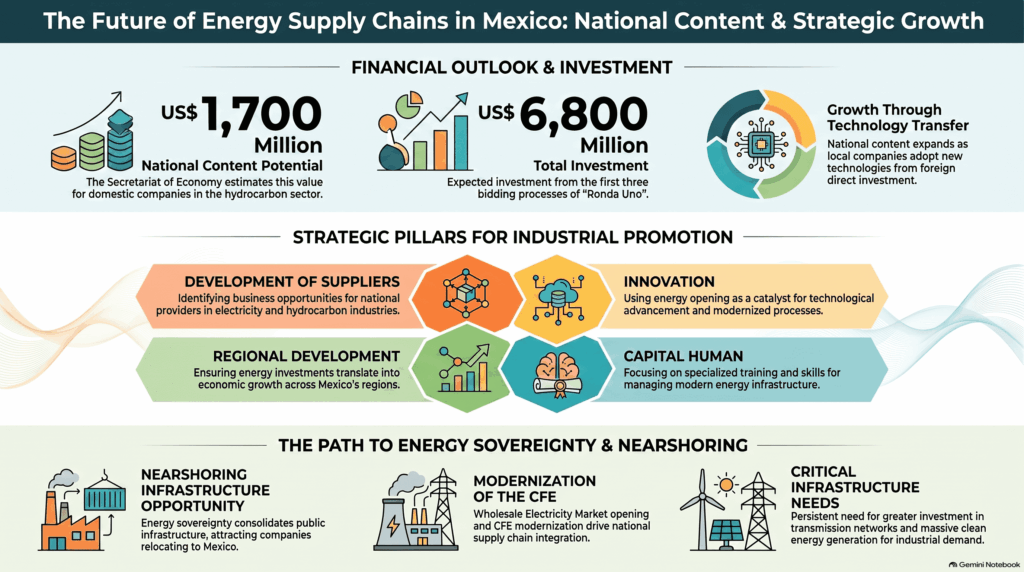
Furthermore, the Ministry of Economy indicated that domestic content in the hydrocarbons sector could increase through the technology transfer associated with these investments. Additionally, there could be greater integration of the domestic supply chain in the energy sector.
The Ministry of Economy, in consultation with the Ministry of Energy, has defined strategies for the industrial promotion of local production chains and direct investment in the hydrocarbons and electricity industries. These strategies are based on the principles of the Industrial Promotion Policy implemented by the Ministry. This policy is structured around four pillars:
- Supplier Development.
- Innovation.
- Regional Development.
- Human Capital.
These pillars are organized into five objectives and 33 lines of action. They primarily aim to assess the demand for goods and services in the electricity and hydrocarbons industries. In doing so, they seek to identify business opportunities for domestic suppliers, drive regional development, and encourage investment.
Electric Power Industry
The opening of the electric power sector presents a significant opportunity for domestic companies to become part of the new production chain. As a result of the opening of the Wholesale Electricity Market and the modernization of the Federal Electricity Commission (CFE), it is expected that companies will be able to capitalize on the technology transfer associated with these investments. Moreover, they may achieve greater integration of the domestic supply chain within the energy sector.
From a geostrategic perspective, energy sovereignty opens the door to consolidating an integrated public infrastructure for nearshoring. However, there remains a critical lack of greater investment in transmission networks and large-scale clean generation to meet industrial demand.