
Brazilian production of animal feed and supplements will grow at a year-over-year rate of 3% in 2026, according to projections by the Brazilian Animal Protein Association (ABPA).
This forecast was announced during the 2026 Brazil International Animal Protein Show (SIAVS), being held in São Paulo.
This agro-industrial event brings together companies, specialists, and organizations to discuss production, technology, markets, and health issues related to meat, eggs, and animal feed. It promotes business, innovation, and industry cooperation.
Brazilian Production of Animal Feed
SIAVS 2026 will be attended by approximately 31,000 visitors, 3,250 producers, and 400 exhibitors.
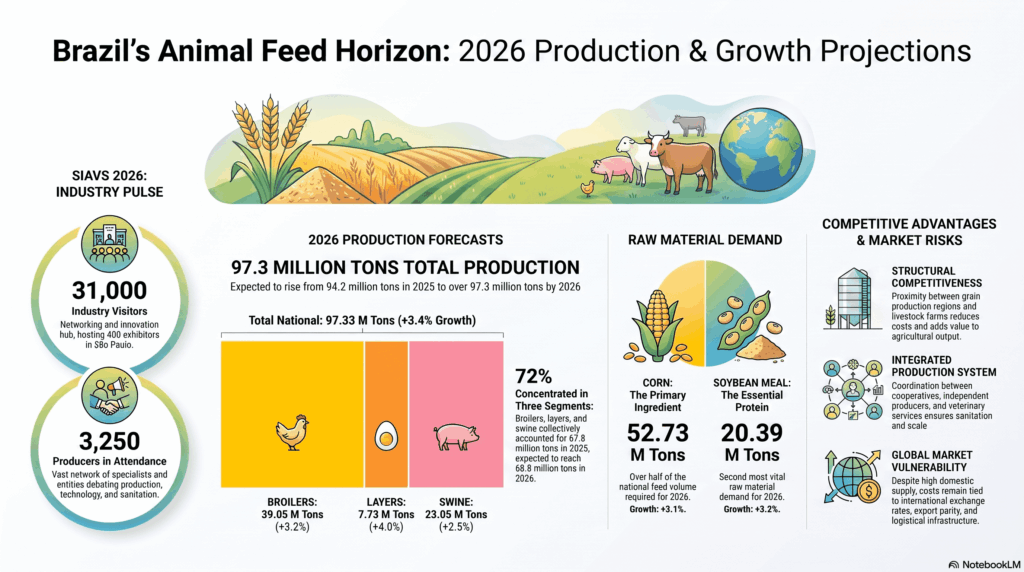
Brazilian production of animal feed and supplements was estimated at 94.2 million metric tons in 2025 and could reach 97.3 million in 2026.
Broiler chickens, laying hens, and pigs together accounted for 67.8 million metric tons in 2025, representing nearly 72% of the national volume. By 2026, combined demand from these segments is projected to reach 69.8 million metric tons.
Major production segments in 2025 (millions of metric tons):
- Broiler chickens: 37.85 in 2025; 39.05 in 2026; change +3.2%.
- Laying hens: 7.43 in 2025; 7.73 in 2026; change +4.0%.
- Pigs: 22.48 in 2025; 23.05 in 2026; change +2.5%.
- National total — animal feed and supplements: 94.18 in 2025; 97.33 in 2026; change of +3.4%.
Main macro-ingredients in animal feed
Corn accounts for more than half of the estimated volume of animal feed and supplements produced in the country. Soybean meal is the second-largest raw material by volume. In 2025, the animal feed industry used approximately 51.1 million metric tons of corn and 19.8 million metric tons of soybean meal.
Broiler chickens, laying hens, and pigs accounted for nearly 42.9 million metric tons of corn and 15.6 million metric tons of soybean meal used in compound feed.
Ingredients (Millions of metric tons):
- Corn: 51.13 in 2025; 52.73 in 2026; change +3.1%.
- Soybean meal: 19.75 in 2025; 20.39 in 2026; change +3.2%.
Availability and Competitiveness
The domestic supply of corn, soybeans, and soybean meal is a structural component of the competitiveness of Brazilian animal protein. Large-scale agricultural production, domestic soybean processing, and the proximity between grain-producing hubs and livestock-raising regions support a large-scale compound feed industry. Furthermore, the conversion of these inputs into meat and eggs also adds value to domestic agricultural production.
However, domestic availability does not mean that costs are independent of the international market. Corn and soybean prices remain subject to the exchange rate, export parity, harvest conditions, inventories, domestic and foreign demand, and logistics costs.
Thus, the scale of input production constitutes a fundamental advantage, while effective competitiveness also depends on productivity, industrial efficiency, infrastructure, and economic stability.
How the Production System Works
Brazilian production combines integrated and independent producers, cooperatives, agribusinesses, input suppliers, technical assistance, official veterinary services, inspection, and distribution. This network enables health coordination, standardization, economies of scale, and the ability to serve different markets.