

Boeing’s aircraft production will be affected if the company is not exempted from new regulations, warned the U.S. Chamber of Commerce (USCC).
Granting this request would allow Boeing to meet customer demand by delivering 35 dedicated 777 freighter (777F) aircraft. On the other hand, completion of these aircraft is scheduled for after January 1, 2028. That is the deadline for implementing the new fuel efficiency standards set forth in Part 38 of Title 14 of the Code of Federal Regulations.
The USCC noted that the 777F will not comply with these standards, although its successor, the 777-8F, will (though it will not be certified in time).
Boeing Aircraft Production
The 777F is the only wide-body cargo aircraft currently in production and the most fuel-efficient.
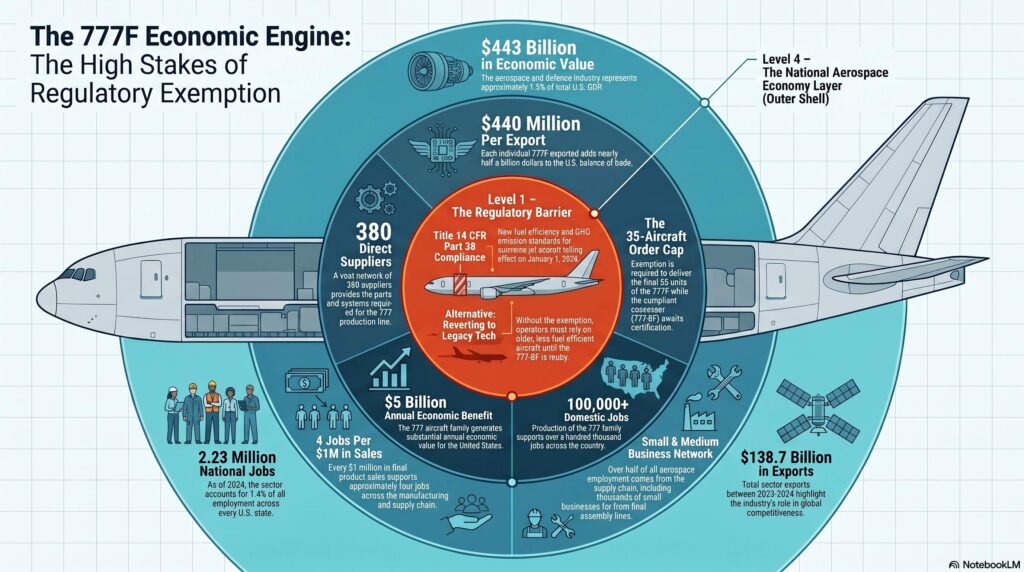
If the FAA does not grant the exemption, the USCC argued that older, less fuel-efficient aircraft would have to be used. This would continue until the 777-8F obtains certification.
In addition, the USCC added that denying the request would have negative consequences for the communities responsible for the production of Boeing 777 aircraft across the United States. This would occur during the two years it will take Boeing to complete this latest order for the 777F.
For example, the entire 777 family of aircraft generates more than $5 billion in annual economic benefits and supports 380 suppliers. In addition, more than 100,000 jobs across the country depend on them. The 777F is a major component of these benefits, and each exported 777F contributes a list price value of $440 million to the U.S. trade balance.
For these reasons, the USCC asked the Federal Aviation Administration (FAA) to support Boeing’s request to be exempted from regulations prohibiting the issuance of an original airworthiness certificate for certain aircraft.
The ban covers subsonic jet aircraft that do not meet specific fuel efficiency and greenhouse gas emissions limits.
To avoid confusion: the USCC operates within the United States as the country’s largest business chamber, focusing on domestic policy and lobbying. In contrast, the American Chambers of Commerce (AmCham) operate in other countries and promote trade and investment between U.S. companies and local governments.
Aerospace Industry
The U.S. aerospace sector is a cornerstone of the national economy and a major source of high-value manufacturing, innovation, and exports.
In 2024, the aerospace and defense industry generated more than 2.23 million jobs across all U.S. states. Furthermore, it accounted for approximately 1.4% of total employment in the country.
In addition, the industry generated $443 billion in economic value, representing 1.5% of U.S. GDP.
Finally, U.S. exports from the aerospace and defense sector reached $138.7 billion between 2023 and 2024. This underscores the sector’s importance to U.S. trade, manufacturing, and global competitiveness.
Supply Chain for Aircraft Manufacturing
The industry’s success depends on a broad and deeply integrated supply chain. More than half of the jobs in the aerospace and defense sector come from suppliers that provide parts, systems, materials, and services to final manufacturers.
This network includes thousands of small and medium-sized businesses across the country and supports additional jobs in communities far beyond the final assembly line. In practical terms, every $1 million in sales of final products supports approximately four jobs in manufacturing and the supply chain combined.