
The automotive industry has increased its use of tariff preferences under the United States-Mexico-Canada Agreement (USMCA), according to data from the U.S. Trade Representative (USTR).
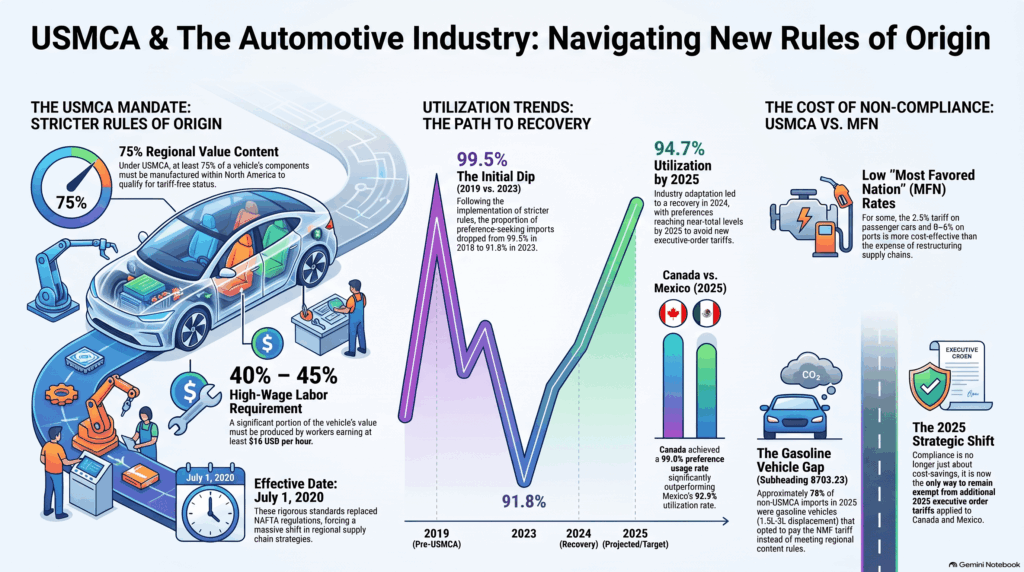
In the automotive sector, the USMCA tightened rules of origin. It now requires that at least 75% of a vehicle’s content be manufactured with parts originating in North America. Additionally, between 40% and 45% of the vehicle’s value must be produced by workers earning at least $16 per hour. This treaty entered into force on July 1, 2020.
USMCA Tariff Preferences
In this context, auto parts plants in the United States, Mexico, and Canada rely on duty-free intraregional trade. Strictly complying with the USMCA’s rules of origin is now even more critical: only by doing so will products be exempt from the additional tariffs imposed on Canada and Mexico via executive orders in 2025.
Tariff Rates
U.S. Most-Favored-Nation (MFN) tariffs on automobiles and auto parts are relatively low. As a result, they often do not incentivize changes in the supply chain that would enable compliance with the USMCA’s rules of origin.
The MFN tariff for passenger vehicles is 2.5%, while for most auto parts it ranges from 0% to 6%. In this context, the difference between paying the MFN tariff and meeting the rules of origin may be limited.
Following the entry into force of the USMCA and the implementation of stricter rules of origin, the share of U.S. vehicle imports from Canada and Mexico that qualified for preferential duty-free treatment fell from 99.5% in 2019 to 91.8% in 2023. However, according to the USTR, this proportion began to recover in 2024 and reached 94.7% in 2025.
Trend in Regional Automotive Content
In 2025, a larger share of vehicles from Canada took advantage of the USMCA compared to those from Mexico: 99.0% of vehicle imports from Canada used the preferential treatment, compared to 92.9% of arrivals from Mexico.
Finally, approximately 78% of vehicle imports from Canada and Mexico that did not benefit from the USMCA in 2025 fell under subheading 8703.23 (gasoline-powered passenger vehicles with engine displacements between 1.5 and 3 liters), a segment where paying the MFN tariff remains relatively attractive compared to the cost of meeting regional content requirements.